

Enterprise AI governance is the set of policies, controls, and lifecycle practices that determine what data AI can access, how it is classified and retained, and who is accountable for it. AvePoint's State of AI 2026 Report found that data security and data management concerns, not model capability, are the leading cause of AI deployment delays.
Key Takeaways
- AI deployment delays are structural, not something to wait out. Nearly 9 in 10 organizations delayed generative AI (86.9%) and AI agent (86%) deployments by nearly six months on average, driven primarily by data security and data management concerns, not model capability.
- AI is now a major source of the data it has to govern. AI-generated content is 35.5% of enterprise data today, projected to reach 42.1% within 12 months.
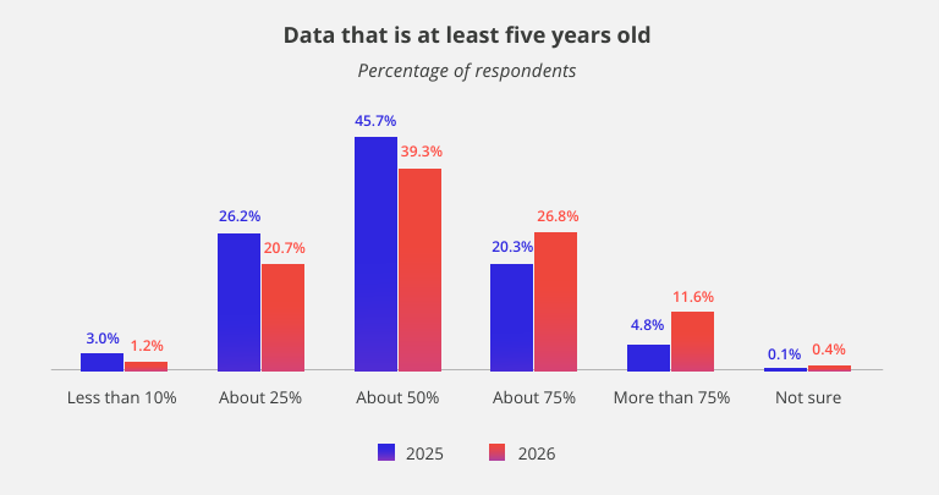
- Stale data compounds the problem. 78.1% of organizations say at least half their data is more than five years old, up from 70.7% in 2025.
- The cost of skipping governance is rising. 89.5% of organizations experienced at least one generative AI-related security breach in the past 12 months and canceled generative AI rollouts rose from 31.7% to 40.7% year over year.
- Investment is shifting from adoption to control. Organizations are prioritizing third-party governance and data security tools ahead of new AI licenses.
- Data governance and AI governance are related but not identical. Data governance manages the lifecycle of all enterprise data; AI governance adds control over what AI can access, do, and produce with that data.
- Five foundations separate ready organizations from delayed ones. Data quality, lifecycle controls, access management, classification, and AI-generated content governance.
What Does Enterprise AI Governance Control?
Enterprise AI governance is the framework of policies, controls, and accountability structures that determine what data AI systems can access, how that data is classified and retained, and who is responsible when something goes wrong. It extends traditional data governance to cover AI-specific risks: model access, AI-generated content, and autonomous agent activity.
AvePoint's State of AI 2026 Report found that the limiting factor for enterprise AI is no longer model capability; it is governance and operational readiness. As AvePoint Chief Risk, Privacy & Information Security Officer Dana Simberkoff put it in the report, data readiness has become AI readiness.
For governance leaders, that reframes the AI rollout conversation. The question is no longer which model to license, but whether the data that model will touch is classified, current, and access-controlled enough to hand over.
Learn How to Build AI Trust
Join top AI leaders at AvePoint's AI Virtual Summit on September 10 to see how they scale their organizations with AI while maintaining trust.
Why Are 9 in 10 Organizations Delaying AI Deployment by Almost 6 Months?
Nearly nine in 10 organizations delayed AI deployment in the past year: 86.9% delayed generative AI (GenAI) rollouts and 86% delayed AI agent rollouts, both by an average of almost six months. AvePoint's State of AI 2026 Report found the leading cause in both cases is unresolved data security and data management risk, not model capability.
The delay curves for GenAI and AI agents are nearly identical: 5.88 months average delay for GenAI, 5.92 months for AI agents. That consistency matters. It means the constraint is not the technology itself, since two very different technologies are being delayed by the same causes and for almost the same length of time. The constraints are data security, data quality, and management readiness, and those delays are structural rather than temporary.
The trend is getting more serious, not less. Organizations delaying rollout specifically to address security concerns rose from 22.1% to 34.5% year over year, a 56.5% increase. Organizations canceling GenAI rollouts entirely rose from 31.7% to 40.7%. Meanwhile, the share doing nothing to mitigate AI security concerns dropped from 8.3% to 2.5%. Fewer organizations are ignoring the problem, but more of them are responding by slowing down or walking away rather than by fixing the underlying governance gap.
Why Is AI-Generated Data Making Governance Harder?
AI-generated data behaves differently from human-created records: it lacks clear lineage, carries uncertainty, and can be reused as training input for other AI systems. AvePoint's State of AI 2026 Report found AI-generated content already makes up 35.5% of enterprise data, a figure expected to reach 42.1% within 12 months.
This growth is landing on top of data environments that are already straining. More than four in five organizations (84.1%) now manage at least one petabyte of data, and average data growth is expected to rise from 31.8% over the past 12 months to 39.1% over the next year. Layered on top, 78.1% of organizations say at least half of their data is more than five years old, up from 70.7% in 2025.
The practical risk is what the report calls redundant, obsolete, and trivial (ROT)content. Training and reasoning on ROT content increases the probability of irrelevant output and poor decision-making, and as AI agents begin acting autonomously on that output, governance failures can propagate across systems, workflows, and decisions at machine speed rather than human speed.
What Is the Difference Between Data Governance and AI Governance?
Data governance manages the lifecycle, quality, and access controls of all enterprise data. AI governance builds on top of that foundation to control what AI systems can access, what they can do with it, and how their output and actions are monitored, audited, and corrected. Without data governance in place first, AI governance has nothing solid to enforce.
| Data Governance | AI Governance |
| Scope: all enterprise data across its lifecycle | Scope: what AI systems can access, produce, and act on |
| Primary controls: classification, retention, access policy | Primary controls: usage guardrails, model and agent permissions, output monitoring |
| Primary risk if missing: oversharing, stale or ROT data, compliance gaps | Primary risk if missing: unauthorized data exposure via AI, AI-generated content sprawl, unreviewed agent actions |
| Typical owner: IT, records management, compliance | Typical owner: security, compliance, and AI governance[JM1] leads, shared across security, IT, and the business |
| Report finding: 78.1% of data is 5+ years old | Report finding: 89.5% of organizations had a GenAI-related security breach in the past year |
What Are the 5 Data Governance Foundations You Need Before Deploying AI?
Organizations that deploy AI without delays or breaches build five foundations first: data quality, lifecycle controls, access management, classification, and governance over AI-generated content itself. Skipping any one of them can turn a model rollout into a six-month delay or a security incident.
1. Data quality. Reduce ROT content before AI accesses or reasons over it, since ROT content increases the odds of irrelevant output and poor decisions.
2. Lifecycle controls. Apply retention and disposition so stale data stops compounding. 78.1% of organizations report that at least half their data is more than five years old.
3. Access management. Verify who, and what, including AI tools and agents, can reach sensitive data before AI is turned on, not after.
4. Classification. Know what is sensitive before AI can reach it. Classification is what turns a generic access policy into an enforceable one.
5. AI-generated content governance. Govern the fastest-growing category of data in the enterprise. AI-generated content is on pace to grow from 35.5% to 42.1% of enterprise data within 12 months.
These five foundations map directly to the governance gaps behind this year's delay and breach numbers: skip data quality and lifecycle controls, and AI reasons on ROT content; skip access management and classification, and AI surfaces oversharing the moment it is switched on; skip AI-generated content governance, and the fastest-growing share of enterprise data goes unmanaged.
What Does an Enterprise AI Governance Framework Look Like Across Microsoft 365, Google Workspace, and Salesforce?
An AI governance framework only works if it applies consistently across every cloud environment AI touches, not just the one an organization set up first. Microsoft 365 Copilot, Google Workspace's Gemini, and Salesforce Einstein each inherit whatever classification, retention, and access controls already exist in their environment.
In practice, most organizations govern Microsoft 365 first, since it is usually the most mature environment and the one Copilot lands in earliest. That creates a false sense of coverage. A governance framework that is strong in Microsoft 365 and undefined in Google Workspace or Salesforce is not an enterprise framework, it is a Microsoft 365 policy with a broader name. The five foundations above need to be assessed and enforced per cloud environment, not assumed to transfer automatically from one to the next.
How Does AI Governance Change When Agents Start Taking Action Instead of Just Producing Content?
GenAI governance is primarily about controlling what AI can access and produce. AI agent governance adds a harder requirement: controlling autonomous actions taken across systems, often without a human reviewing them first. A governance framework built only for content output does not cover an agent that can move a file, send an email, or update a record on its own.
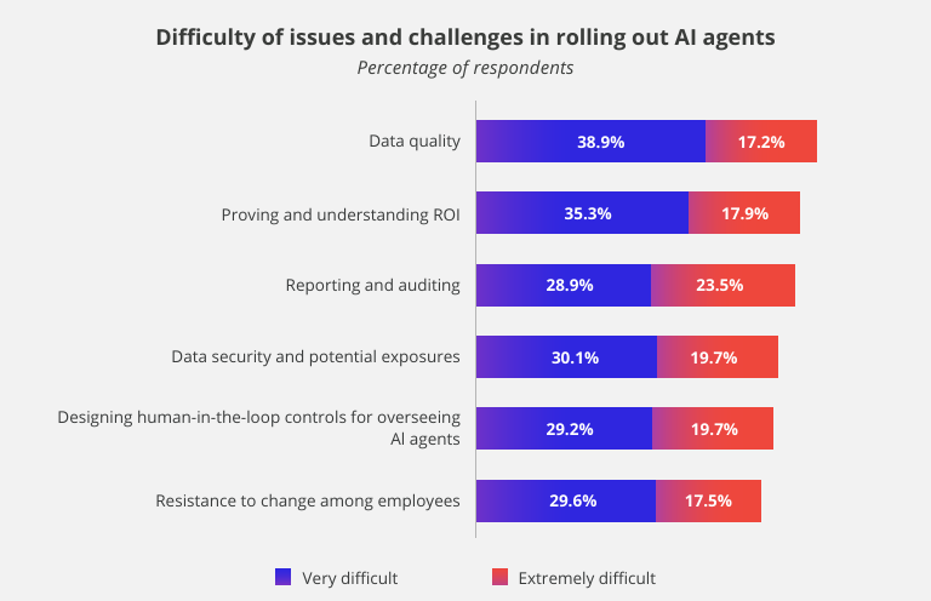
AvePoint's State of AI 2026 Report found that 88.4% of organizations experienced at least one security breach due to AI agents in the past 12 months, and 95.5% had taken at least one action to mitigate agent-related security concerns, most commonly adding human-in-the-loop controls. Agent governance is significant enough, and different enough from GenAI governance, that it deserves its own dedicated framework, which AvePoint covers in a companion piece on AI agent management.
What Happens When Organizations Skip These Governance Foundations?
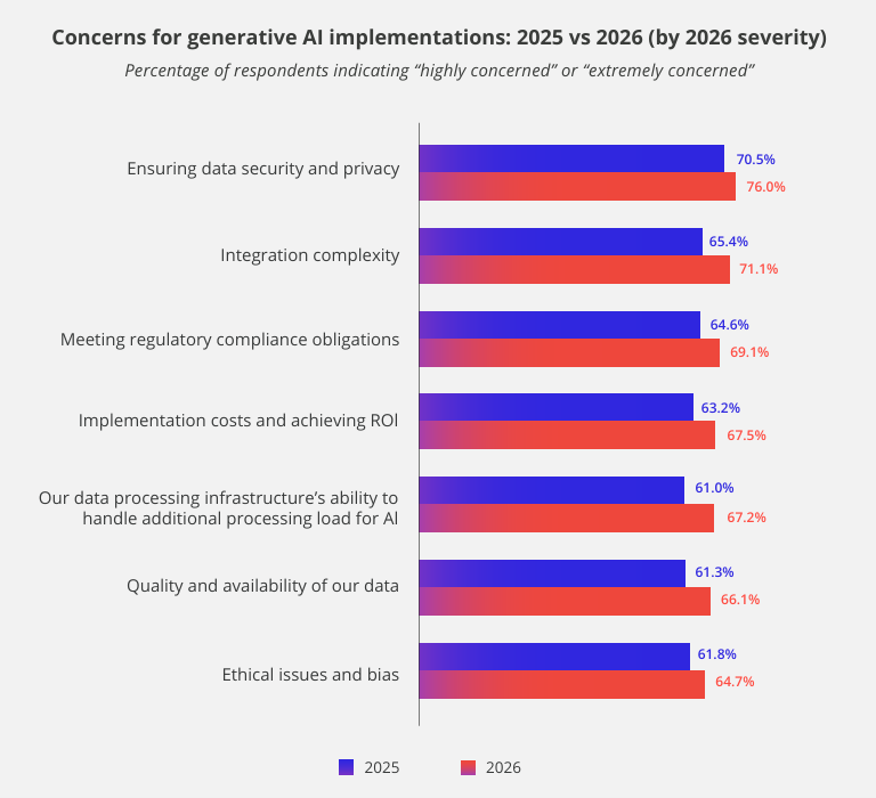
Organizations that deploy AI without these foundations in place experience more breaches, longer delays, and a rising rate of canceled projects. AvePoint's State of AI 2026 Report found that 89.5% of organizations experienced at least one GenAI-related security breach in the past 12 months, with an average of 2.52 breach types per organization, up from 75.1% in 2025.
The financial conversation is shifting as a result. Investment intent is moving toward third-party governance tools and data security tools rather than additional AI licenses, and the cost of those licenses is increasingly judged against whether the organization can actually prove the value and control the risk, not just the sticker price. Skipping governance does not avoid the cost. It moves the cost from a planned investment to an unplanned breach, delay, or cancellation.
What Best Practices Help Organizations Build an AI Governance Framework Faster?
Organizations that build AI governance frameworks fastest treat data readiness as a prerequisite project, not a parallel one. That means reducing ROT content before AI rollout, not after, and making governance investment part of the AI budget conversation from the start.
- Fix data quality before rollout, not after. ROT reduction is cheaper and faster before an AI project is already delayed.
- Classify before you connect. Classification has to exist before access policy can be enforced against it.
- Govern every cloud the same way. Apply the same five foundations to Microsoft 365, Google Workspace, and Salesforce rather than perfecting one and assuming the rest will follow.
- Separate content governance from agent governance. Agents that take action need auditability and human-in-the-loop controls that content-only governance does not cover.
- Fund governance as part of the AI budget, not after it. Organizations that treat governance as a line item alongside AI licensing delay and cancel less often.
The AvePoint Confidence Platform gives governance teams the classification, lifecycle, and disposition controls that turn a written AI policy into an enforced one, across Microsoft 365, Google Workspace, Salesforce, and other cloud environments.
Frequently Asked Questions
What is enterprise AI governance?
Enterprise AI governance is the framework of policies, controls, and accountability structures that determine what data AI systems can access, how that data is classified and retained, and who is responsible when something goes wrong.
What is the difference between data governance and AI governance?
Data governance manages the lifecycle, quality, and access controls of all enterprise data. AI governance builds on that foundation to control what AI can access, produce, and do with that data, including monitoring and auditing AI-generated output and agent actions.
What is enterprise AI governance?
Enterprise AI governance is the framework of policies, controls, and accountability structures that determine what data AI systems can access, how that data is classified and retained, and who is responsible when something goes wrong.
What is the difference between data governance and AI governance?
Data governance manages the lifecycle, quality, and access controls of all enterprise data. AI governance builds on that foundation to control what AI can access, produce, and do with that data, including monitoring and auditing AI-generated output and agent actions.
Why do AI deployments get delayed?
AI deployments get delayed primarily because of unresolved data security and data management risk, not model limitations. AvePoint's State of AI 2026 Report found 86.9% of GenAI rollouts and 86% of AI agent rollouts were delayed by an average of almost six months for these reasons.
What is AI-generated data, and why is it a governance risk?
AI-generated data is content created by GenAI systems rather than people. It is a governance risk because it lacks clear lineage, can be reused as training input for other AI systems, and is growing fast, from 35.5% of enterprise data today to a projected 42.1% within 12 months.
What is ROT data, and why does it matter for AI?
Redundant, obsolete, and trivial (ROT) data matters for AI because training or reasoning on ROT content increases the probability of irrelevant output and poor decision-making, and 78.1% of organizations report that at least half their data is more than five years old.
What is an AI governance framework?
An AI governance framework is a named, repeatable structure of foundations, typically data quality, lifecycle controls, access management, classification, and AI-generated content governance, that an organization applies consistently before and during AI deployment.
What does AI governance mean for Microsoft 365, Google Workspace, and Salesforce?
AI governance means applying the same classification, retention, and access controls across every cloud environment AI touches. Microsoft 365 Copilot, Google Workspace's Gemini, and Salesforce Einstein each inherit whatever governance already exists in their respective environments, so uneven coverage creates uneven risk.
How does AI agent governance differ from GenAI governance?
GenAI governance primarily controls what AI can access and produce. AI agent governance additionally controls autonomous actions agents take across systems, often without human review, which is why 88.4% of organizations experienced at least one agent-related security breach in the past 12 months.
What is a good AI governance framework benchmark for enterprises?
A strong AI governance framework benchmark includes continuous data classification, tested access controls, lifecycle and disposition policies applied across every cloud, and governance specifically covering AI-generated content and agent activity, not just GenAI output.
How often should organizations review their AI governance framework?
Organizations should review their AI governance framework at least quarterly, since AI-generated content volume, agent deployments, and unsanctioned tools usage all accumulate continuously between review cycles.
Related Questions

Jared Matfess is an AI Architect at AvePoint with over two decades of industry and consulting experience. A Microsoft MVP and a recently published author, he loves solving business problems with technology. He frequently speaks at industry events and conferences, inspiring teams to realize the full potential of their investment in Microsoft technologies.