
Key Takeaways
- AI has raised the stakes for lifecycle management. Copilots and agents can find and use any content they can reach. Stale or misclassified data now affects security, compliance, and AI accuracy, not just storage costs.
- ROT data is a risk, not just clutter. Data kept past its retention period is unmonitored sensitive data that could be exposed in breaches, insider incidents, or e-discovery.
- Visibility comes before action. AvePoint's Discovery and Analysis scans environments down to the version level. Teams can then archive, reduce version sprawl, or dispose of content defensibly, and some customers have saved up to 60% on storage.
- Governance has to work at two levels. AvePoint manages the lifecycle of workspaces (teams, sites, groups, apps, agents) and content (retention, archiving, records, disposal) to stop sprawl at the source.
- AI makes lifecycle decisions easier to act on. Intelligent storage optimization and AI-generated lifecycle policies turn weeks of work into minutes, while people still approve what runs.
Most organizations already know they have a data problem. Storage costs continue to rise, but the larger challenge is what those costs represent: stale files nobody owns, duplicate content nobody tracks, and data retained long past its business value.
Every terabyte sitting past its retention rate is unmonitored sensitive data, sitting in the blast radius of the next breach, insider incident, or e-discovery request.
The people responsible for storage budgets often lack confidence in what can be safely removed. Meanwhile, the people most familiar with the content tend to keep everything. That gap is where redundant, obsolete, and trivial (ROT) data accumulates. It is also why AI may surface content that should have been archived or disposed of years ago.
Data lifecycle management is not a new challenge. AvePoint has been helping organizations minimize, govern, classify, retain, archive, and defensibly dispose of data for more than 25 years. What has changed is the urgency.
In the era of AI, organizational data becomes more discoverable, more accessible, and potentially more influential in the outputs generated by copilots, agents, and large language models (LLMs). Organizations can no longer afford to treat lifecycle management as a storage optimization exercise alone. It is now a foundational requirement for security, compliance, governance, and trusted AI.
As the unifying trust layer for AI, AvePoint makes sure the content your agents and copilots can reach is content they should reach: accurate, current, correctly classified, and appropriately permissioned. Data minimization is not simply housekeeping before an AI rollout. It is a prerequisite for producing more trustworthy outputs.
How Do You Identify and Reduce ROT Data Before Deploying AI?
Effective data lifecycle management begins with visibility. Through AvePoint’s Discovery and Analysis, organizations can deep-scan environments down to the version level to surface what drives both cost and AI exposure. This enables teams to understand not only where data exists, but also whether it remains valuable, compliant, and appropriate to retain.
Once content is identified, organizations can take action based on both risk and business value:
- Move and archive. Shift stale content out of active collaboration spaces into a governed archive with restorable stubs.
- Optimize version sprawl. Intelligently reduce excessive file versions based on metadata, project status, or file size, and business context — not just raw age.
- Preserve and dispose defensibly. Declare records where preservation is required or dispose of ROT against formal business classification schemes with an auditable record of what was removed and why.
AvePoint customers have saved up to 60% in storage costs through automated archiving and version control. But the true outcome isn't just a smaller bill; it's ensuring AI models only learn from current, authoritative data while keeping sensitive content out of harm's way.
How Does Kinetic Classification Keep Data Governance Current?
Just as data lifecycle management evolves alongside your data as your organization grows and changes, the systems used to identify and assess data risk must evolve as well.
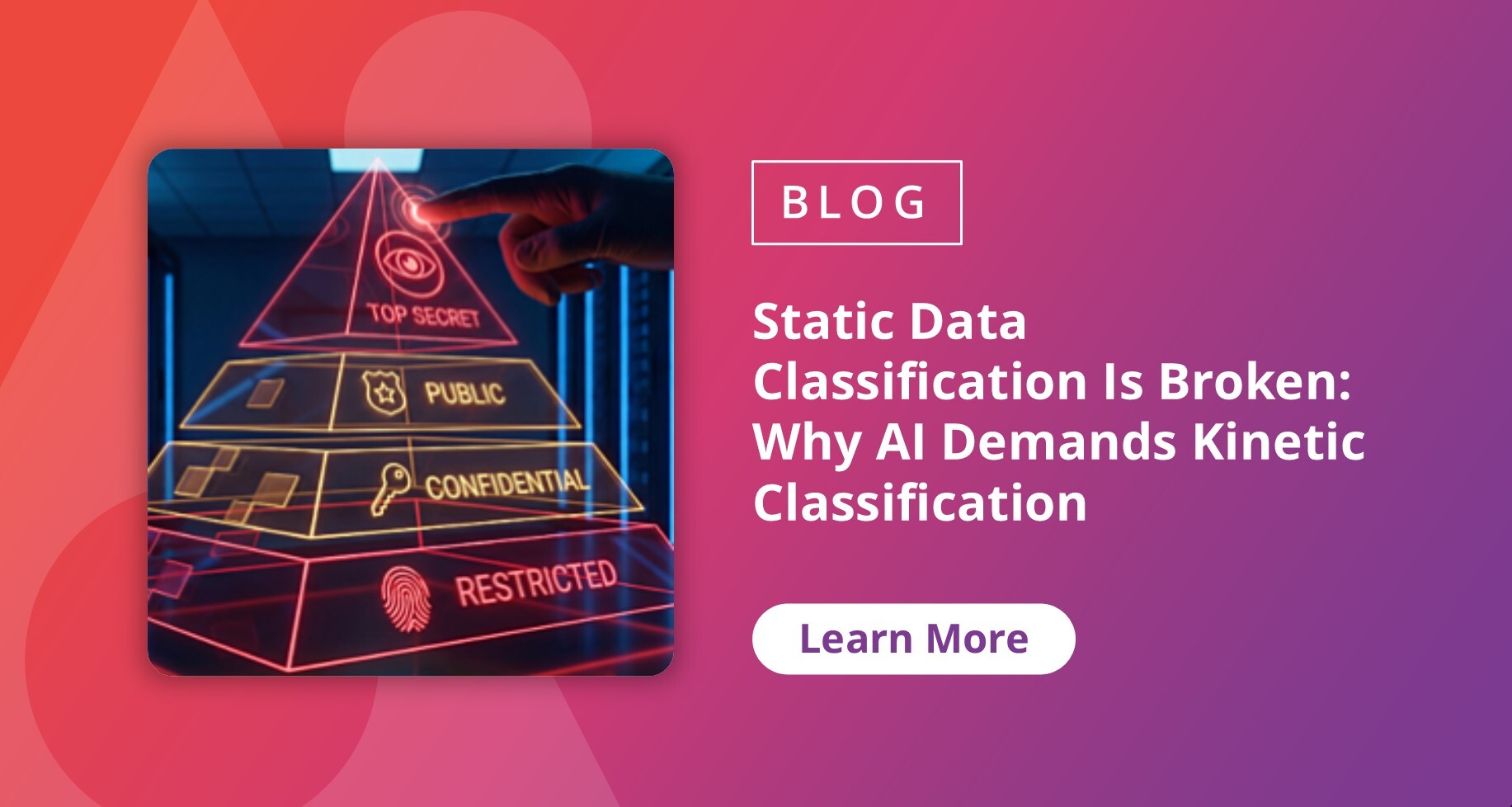
Traditional classification approaches were designed for a different era. Static, point-in-time scanning cannot keep pace with modern data sprawl. Sensitivity changes: Permissions drift, business contexts shift, and file activity spikes.
Instead of treating classification as a one-time tag, AvePoint’s Kinetic Classification runs as a continuous loop, re-evaluating content and permissions on incremental scans as environments evolve.
As risk and sensitivity are re-evaluated as conditions change, classification context remains connected to the content itself. Lifecycle and protective actions can then be applied using that shared understanding.
The result is governance that reflects the current state of data, not the state it was in during the last review cycle.
What Are the Two Levels of Data Lifecycle Governance?
While the storage bill is often the symptom, unmanaged sprawl is the root cause. Files do not accumulate in a vacuum. They accumulate inside ungoverned teams, sites, groups, and workspaces that are rarely reviewed and often lack clear ownership. Every ungoverned workspace adds cost, risk, and clutter — that can compound over time.
That is why AvePoint applies lifecycle management at two distinct levels:
- Workspace lifecycle management. At the workspace layer, lifecycle management is applied across teams, sites, groups, apps, agents, and more. Leveraging user attestations, organizations continuously validate objects’ purpose, sensitivity, and business criticality over time, and safely retire them when no longer needed.
- Data lifecycle management. At the content level, organizations automate retention, archiving, version optimization, records declaration, and defensible disposal to continuously reduce ROT and maintain compliance.
From top to bottom, these capabilities create an automated governance layer that helps organizations get rid of what’s no longer needed and what may be driving non-compliance or risky access and permissions.
How Can AI Simplify Data Lifecycle Management?
Dashboards and centralized visibility are the first step, but they don’t necessarily make insights actionable. Even when organizations have visibility into what their ROT looks like, one of the biggest challenges is determining what to do about it. That’s why AvePoint leverages AI to make data lifecycle decisions more intuitive and to help organizations move forward.
- Intelligent storage optimization (currently in preview) uses AI to reason over the analysis of a customer’s ROT, duplicates, version sprawl, and inactive content and recommend a tailored storage optimization strategy for your environment. Users can submit prompts like “Show me my biggest savings opportunities," or “Reduce costs without deleting content," then choose how conservative or aggressive to be, and simulate exactly which sites and documents would be affected, with projected savings, before anything runs.
- Prescriptive data lifecycle policy creation reduces weeks of regulatory research and departmental workshops into a matter of minutes. Input basic information using natural language prompts; it is recommended that you tailor classification terms, metadata, and retention rules to your industry, region, and the specific part of the business you're scoping with, even citing the legislative requirements.
AI assistance removes the expertise bottleneck and the blank-page problem, while leaving the human firmly in control of what executes.
The Future of Data Lifecycle Is Continuous Governance
Reducing storage costs is valuable. Reducing your attack surface, improving compliance readiness, strengthening AI trust, and keeping data environments continually governed is what delivers long-term business value.
For 25 years, AvePoint has helped organizations move beyond one-time cleanup exercises toward sustainable governance programs that continuously reduce risk while maximizing the value of data.
If ROT data continues to return after each cleanup, visibility is not the only challenge. The organization also needs sustainable governance.
Take Control of Your Data Growth Before It Controls Your AI
Discover how AvePoint helps organizations continuously reduce ROT, strengthen security posture, optimize storage costs, and build a trusted foundation for AI.

Frequently Asked Questions
What is data lifecycle management?
It's how an organization manages data from creation to disposal: minimizing, classifying, retaining, archiving, and defensibly deleting it. The goal is to keep only data that is still valuable, compliant, and secure.
How does data lifecycle management support trusted AI?
It makes sure the data AI can reach is accurate, current, correctly classified, and properly permissioned. That's why data minimization comes before a trustworthy AI rollout.
How does AvePoint help organizations reduce ROT and storage costs?
AvePoint Discovery and Analysis finds stale, duplicate, and inactive content. Automated archiving, version optimization, and defensible disposal then reduce ROT while keeping an audit trail.
What is AvePoint Kinetic Classification?
It's a continuous classification process that re-checks content and permissions as environments change. Governance then reflects the current state of the data, not the last review.
Related Questions
→ How can organizations govern Microsoft 365 file-level archiving at scale?
→ Why do organizations delay AI deployment on purpose?
→ What security factors build trust in AI?
→ How can AI-powered knowledge management secure critical enterprise data?

Clara Hinchcliffe is a Product Marketing Manager at AvePoint, working on go-to-market strategy for AvePoint’s data security and information lifecycle solutions. With a background in market research, Clara brings a data-driven mindset to product marketing, spearheading initiatives like customer focus groups to ensure product-market fit. In her spare time, Clara enjoys traveling, hiking, and discovering new live music venues.