

Key Takeaways
- AI trust is the evidence-based confidence that an AI system operates reliably, securely, and within policy.
- Trustworthy AI is defined by measurable characteristics, including validity, safety, security, transparency, explainability, privacy, and fairness.
- The AI trust gap emerges when AI adoption, particularly agentic AI adoption, advances faster than governance and controls.
- An AI trust layer brings identity, data governance, runtime enforcement, monitoring, and recovery together across AI environments.
- Trust scores and trust signals can help quantify AI trust when they are calibrated, transparent, and continuously validated.
An AI agent may inherit permissions that allow it to surface a sensitive HR file or initiate a purchase outside its intended scope. In either case, a useful-looking response or action can create a policy violation.
This illustrates an important shift in enterprise AI: AI systems no longer only generate content. Agents can also call tools, trigger workflows, and act across applications. As their capabilities expand, organizations need controls that keep AI behavior aligned with business policies and authorized access.
AI trust provides that foundation. This guide explains what AI trust means, how organizations establish it, how they measure it, and how they monitor it across data, models, and agents. The goal is to help enterprises scale AI adoption while maintaining security, governance, and resilience.
What Is AI Trust?
AI trust is the measurable confidence that an AI system will produce reliable outputs, protect data, and operate within defined policies and permissions. It is established through governance, technical controls, testing, and continuous verification rather than assumed from a product claim.
Trust is supported by evidence. Controls, logs, evaluations, and documented accountability enable an organization to demonstrate how an AI system operates and whether it continues to meet expectations.
AI trust spans three areas:
- Data: What information the AI system can access, how that information is governed, and how sensitive it is.
- Models: How the system processes information and whether its outputs are accurate, grounded, and reliable.
- Agents: What the system can do when it calls tools, starts workflows, or takes action across applications.
When organizations govern and verify all three, AI trust becomes a demonstrable operational capability.
AI Trust vs. Trustworthy AI
Trustworthy AI describes the qualities of the system itself, such as reliability, safety, security, fairness, and explainability.
AI trust is the justified confidence stakeholders gain when those qualities are supported by evidence.
Put simply, trustworthy AI describes how the system is designed and operated; AI trust describes the confidence that evidence creates.
What Are AI Trust Services?
AI trust services are assessments, assurance activities, and managed services that help organizations evaluate and maintain the trustworthiness of AI systems. They may include AI risk assessments, red-team exercises, model validation, governance program design, and compliance audits.
These services help organizations verify how AI behaves before deployment and monitor whether it continues to operate as intended.
The Core Principles of Trustworthy AI
Trustworthy AI is valid and reliable; safe; secure and resilient; accountable and transparent; explainable and interpretable; privacy-enhanced; and fair.
These characteristics, reflected in the NIST AI Risk Management Framework, provide a practical baseline for evaluating AI systems. Each characteristic should map to controls that an organization can test, monitor, and document.
For example:
- Validity and reliability require evaluations, grounding, and monitoring.
- Security and resilience require safeguards against attacks and tested recovery capabilities.
- Transparency and explainability require documentation, traceability, and clear ownership.
- Privacy and fairness require appropriate data controls, testing, and oversight.
Connecting these principles to controls turns trustworthy AI from a statement of intent into an operating model.
Ensuring Safe, Secure, and Trustworthy AI
Organizations can apply safe, secure, and trustworthy AI principles across the AI lifecycle:
- Safe by design: Identify potential harm and establish appropriate human oversight.
- Secure in deployment: Protect models, data, identities, integrations, and infrastructure.
- Trustworthy at runtime: Monitor outputs, actions, access, and policy alignment.
- Accountable through retirement: Maintain ownership, records, and appropriate controls when systems are changed or decommissioned.
Trustworthy AI Principles
| Principle | What It Means | Example Technical Control |
|---|---|---|
| Valid and reliable | Outputs are accurate and consistent | Evaluation benchmarks, grounding, and drift monitoring |
| Safe | Risks to people and operations are identified and managed | Guardrails and human review for high-risk actions |
| Secure and resilient | The system can withstand attacks and recover from disruption | Prompt-injection defenses, model signing, backup, and recovery |
| Accountable and transparent | Ownership and system behavior are documented | AI inventory, model cards, and audit logs |
| Explainable and interpretable | Relevant decisions and outputs can be understood | Source citations and appropriate explanation methods |
| Privacy-enhanced | Personal and sensitive information is protected | Data classification, least-privilege access, and DLP |
| Fair | Harmful bias is identified and managed | Bias testing and representative training data |
The AI Trust Gap: When Adoption Outpaces Oversight
The AI trust gap is the distance between how quickly organizations deploy AI and how effectively they can govern, secure, and verify it. Today, generative and agentic AI adoption is advancing faster than the controls needed to manage it, creating greater risk as organizations scale.
In practice, the AI trust gap often reflects gaps in AI readiness. When data, governance, and oversight do not keep pace with deployment, organizations may struggle to maintain visibility and control across their expanding AI environments.
The evidence is measurable. AvePoint’s State of AI 2026 report, based on a global study of 750 professionals responsible for information management, data security, or AI programs, found that more than four in five organizations were confident in their ability to prevent unauthorized data access. Yet 62% to 72% of respondents in the high-confidence categories still experienced at least one AI-related unauthorized-access incident in the past year.
This disconnect between confidence and actual incidents makes the AI trust gap clear: organizations are embracing AI faster than they can consistently govern and secure it.
Common AI Trust Challenges
Several recurring challenges can widen the AI trust gap:
- Poor or incomplete data can reduce output reliability.
- Inherited permissions and oversharing can expose sensitive information.
- Unsanctioned AI tools can operate outside established governance.
- Hallucinations and unsupported outputs can undermine decisions.
- Agents can act beyond their intended scope when permissions and guardrails are too broad.
These challenges are interconnected. Stronger data governance can improve output quality, while better visibility can help teams identify unmanaged tools and access risks earlier.
Why Agentic AI Changes the Risk Model
Agentic AI shifts risk from outputs to actions, including tool use, API calls, and workflow triggers. When AI can act rather than only generate content, gaps in governance can have immediate operational consequences.
The scale of this shift is significant. AvePoint’s State of AI 2026 report found that 88.4% of organizations experienced at least one AI agent-related security incident in the past year. Data leakage affected 50.1%, while 49.6% experienced manipulation through malicious or untrusted inputs.
Managing this risk requires AI agent management: the discipline of discovering, governing, securing, and protecting agents across the enterprise. With the right visibility and controls, organizations can expand agent autonomy without allowing it to outpace oversight.
AI Trust and Safety
AI trust and safety is the discipline of helping prevent AI systems from producing harmful, unsafe, or policy-violating outputs and actions. It combines content controls, guardrails, abuse detection, monitoring, and incident response across AI models and agents.
The goal is to keep AI behavior within defined boundaries, including when inputs are unexpected, misleading, or intentionally adversarial.
AI Trust and Safety vs. AI Security
AI trust and safety and AI security overlap, but they address different concerns:
- AI trust and safety focuses on harmful outputs, misuse, and policy alignment.
- AI security focuses on threats to the AI system, including prompt injection, data poisoning, unauthorized access, and model theft.
An effective program addresses both. Security controls protect the system from compromise, while trust and safety controls help keep its behavior aligned with organizational expectations.
AI Trust Boundaries and How They Are Exploited
An AI trust boundary is a point where data, instructions, identities, or permissions move between components with different levels of trust. Those components may include a user, model, retrieval source, agent, or external tool.
Attackers may target these handoffs to influence an AI system or cause it to use privileges in unintended ways. Organizations should therefore apply controls at every boundary, rather than relying only on protections within the model.
| Trust Boundary | Example Technique | Potential Control |
|---|---|---|
| User input to model | Direct prompt injection or jailbreak | Input filtering and prompt hardening |
| External content to model | Indirect prompt injection through documents, email, or web content | Content inspection and trusted-source controls |
| Model to tools/APIs | Excessive agency or inappropriate tool use | Least privilege, scoped tokens, and action approval |
| Agent to agent | Impersonation or unverified delegation | Agent identity and mutual authentication |
| Training or RAG data to model | Data or model poisoning | Data lineage, integrity validation, and model signing |
What Is an AI Trust Layer?
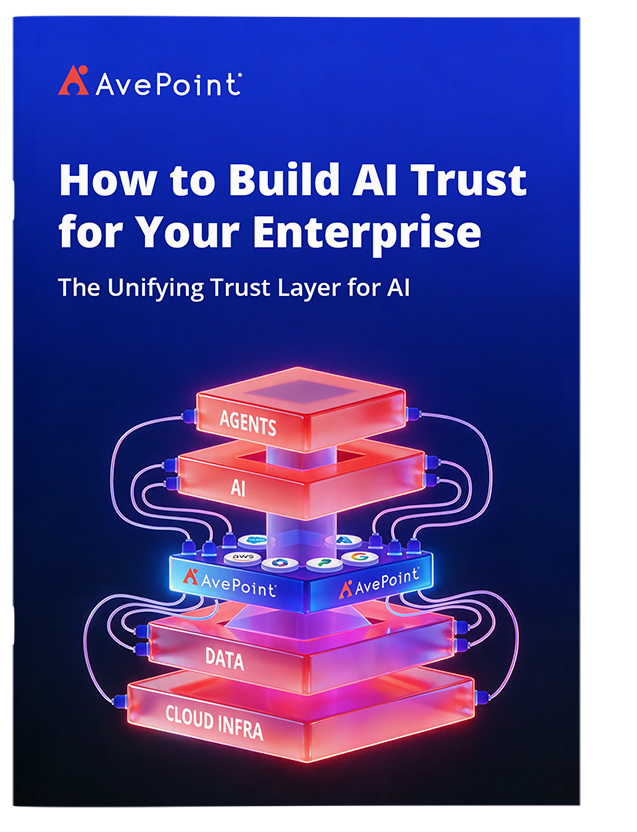
An AI trust layer is a unified control layer that helps govern what AI applications and agents can access, enforce how they operate, monitor their behavior, and support recovery when something goes wrong.
Rather than applying disconnected controls to every AI tool, a trust layer supports consistent governance across data, models, agents, and infrastructure. This enables trust to function as shared enterprise infrastructure.
As organizations introduce more assistants and agents, tool-specific approaches can create fragmented policies, identities, and audit records. A unified trust layer can give security and governance teams a clearer view of exposure, policy enforcement, ownership, and compliance evidence.
Core Components of AI Trust Infrastructure
AI trust infrastructure commonly includes:
- Discovery and inventory of AI assets and agents, including unsanctioned AI.
- Identity and access management for users, models, and agents.
- Data classification, permissions management, and information governance.
- Runtime inspection and policy enforcement.
- Observability, logging, and audit evidence.
- Content and model provenance.
Backup and recovery for data, configurations, and agents.
Together, these capabilities help organizations move from separate tool-level controls to a more consistent and auditable trust architecture.
AI Trust Layer vs. AI Trust Platform
An AI trust layer is an architectural concept that describes how controls work across an AI environment. An AI trust platform is technology that implements and unifies those controls.
When evaluating a platform, organizations should map its capabilities to their requirements across security, governance, monitoring, identity, and resilience. This helps teams understand coverage, integrations, and any remaining control gaps.

AI Trust Frameworks and Risk Management
An AI trust framework is a structured collection of principles, controls, and processes for building, operating, and verifying trustworthy AI.
Common reference points include the NIST AI Risk Management Framework, ISO/IEC 42001, the EU AI Act, and Gartner’s AI TRiSM. Each serves a different purpose, from establishing risk vocabulary to supporting management systems, regulatory obligations, or technical control planning.
Avoid describing these frameworks collectively as “the most widely adopted” unless that comparative claim has an approved supporting source.
AI Trust, Risk, and Security Management
AI TRiSM, a Gartner term for AI trust, risk, and security management, brings governance, trustworthiness, reliability, security, and data protection into a coordinated approach.
The practical objective is to move governance beyond written policy and embed it in controls that teams can apply, monitor, and document throughout the AI lifecycle.
AI Trust and Governance Enablement
Governance can accelerate AI initiatives when organizations provide:
- Preapproved implementation patterns.
- Automated policies and controls.
- Self-service processes with appropriate guardrails.
- Clear ownership and risk tiers.
- Consistent evidence for auditors and decision-makers.
This approach turns AI governance into a repeatable business capability rather than an isolated approval step.
| Framework | Type | Primary Focus | Best Suited For |
|---|---|---|---|
| NIST AI Risk Management Framework | Voluntary framework | Governing, mapping, measuring, and managing AI risk | Establishing a shared risk vocabulary and evaluating AI trustworthiness |
| ISO/IEC 42001 | Certifiable standard | Establishing and maintaining an AI management system | Building an auditable AI governance program |
| EU AI Act | Regulation | Applying obligations based on AI risk classifications | Supporting compliance with applicable EU requirements |
| Gartner AI TRiSM | Analyst framework | Coordinating AI governance, runtime enforcement, information governance, and infrastructure controls | Mapping technical capabilities and controls across the AI environment |
How to Measure AI Trust
What Is an AI Trust Score?
An AI trust score is a quantitative assessment of an AI system, model, output, or agent based on defined metrics. These may include accuracy, groundedness, security posture, data exposure, and policy compliance.
Output-level and system-level scores answer different questions:
- Output-level scores indicate confidence in an individual response or result.
- System-level scores reflect broader governance, security, and operational posture.
A score is useful only when its purpose, methodology, weighting, and limitations are clear.
Evaluating AI Trust Score Accuracy
Organizations can evaluate an AI trust score through:
- Calibration: Compare predicted confidence with observed performance.
- Ground-truth validation: Test against labeled data and appropriate human review.
- Drift testing: Reevaluate the score after changes to the model, prompts, or data.
- Transparent weighting: Document how each metric contributes to the result.
Without ongoing calibration and validation, a score may communicate more confidence than the underlying evidence supports.
AI Trust Signals
AI trust signals are observable evidence that helps stakeholders evaluate an AI system. Examples include model cards, audit logs, certifications, content credentials, evaluation results, red-team findings, and incident records.
Unlike a single score, these signals create a body of evidence that stakeholders can review according to their responsibilities and risk requirements.
AI Trust and Safety Monitoring Tools
AI trust and safety tools help organizations discover, monitor, test, and enforce policies across AI systems. Because AI trust spans data, models, agents, identities, and infrastructure, organizations often need capabilities across several tool categories.
Investment is shifting accordingly. AvePoint’s State of AI 2026 report found that 62.4% of organizations plan to increase investment in tools that monitor AI agents’ actions for policy alignment.
How to Evaluate AI Trust and Safety Compliance Tools
When evaluating these tools, consider:
- Coverage across the organization’s AI environments.
- Alignment with relevant frameworks and requirements (NIST AI RMF, ISO/IEC 42001, and the EU AI Act)
- Audit-ready evidence and reporting.
- Runtime enforcement capabilities.
- Support for data and agent recovery.
- Integration with existing security and governance processes.
| Tool Category | What It Helps Monitor or Manage | Evidence or Insight Produced |
|---|---|---|
| AI governance and inventory | AI assets, owners, use cases, and risk tiers | Visibility, coverage, and accountability |
| AI agent management | Agent discovery, permissions, actions, and lifecycle | Agent ownership, activity, and security posture |
| Data security posture management | Sensitive data exposure, permissions, and oversharing | Data access and exposure risk |
| Runtime guardrails and AI firewalls | Prompts, outputs, tool calls, and agent actions | Detected or blocked policy violations |
| Model evaluation and observability | Accuracy, groundedness, drift, and hallucinations | Model reliability and performance metrics |
| Content provenance | The origin, ownership, and integrity of AI-generated content | Evidence supporting content authenticity |
| AI visibility monitoring for GEO | Brand mentions, citations, and representation in AI-generated answers | Brand visibility and trust signals |
AI Trust-Building Strategies
Organizations can build AI trust through a continuous sequence of discovery, governance, control, monitoring, and evidence:
- Inventory AI tools, models, and agents, including unsanctioned technology.
- Classify data and address inappropriate access before connecting it to AI.
- Assign ownership and risk tiers to AI assets.
- Apply least-privilege access and appropriate guardrails to agents and tool calls.
- Document models, agents, dependencies, and data lineage.
- Monitor outputs, behavior, access, and policy alignment.
- Back up relevant data, configurations, and agents, and test recovery processes.
- Maintain evidence aligned with the organization’s selected frameworks and obligations.
This is an ongoing operating cycle. Models, data, integrations, and agents change, so their controls and evidence must remain current.
Turn AI Trust Into Infrastructure With AvePoint
AI trust does not come from a single control or certification. It is created through coordinated security, governance, monitoring, accountability, and resilience across the AI environment.
AvePoint positions its Trust Layer for AI as a way to unify these controls through the AvePoint Confidence Platform across data, infrastructure, and agents. Before publication, each product-capability statement should be checked against the current approved messaging and product documentation.
AvePoint also connects AI agent management with AgentPulse, including agent discovery, policy-driven governance, and protection for supported agents. Confirm the exact supported capabilities and the “known-good state” recovery language with Product Marketing before release.
Explore the AvePoint’s unifying Trust Layer for AI and learn how to strengthen security, governance, and resilience across your AI environment.
Trust Every AI Action
As the unifying Trust Layer for AI, AvePoint protects, secures, and governs your entire AI estate across data, infrastructure, AI and agents so you can deploy AI with confidence.

Frequently Asked Questions About AI Trust

Timothy Boettcher is a senior go-to-market and product marketing leader and Microsoft MVP for M365 Copilot, specializing in enterprise AI, data governance, and adoption strategy across global markets. He is known for translating complex technology into clear, trusted narratives that help leaders make confident decisions and drive responsible AI adoption at scale.