
Every week brings another headline: an agent that went off script, a model that wasn't honest about what it did, an AI deployment that had to pause mid-stream.
The issue isn't the technology — it’s the trust behind it. Organizations may adopt the same AI platforms, but the ones that scale are those that can prove their AI is governed and secure.
Measurable trust defines trust as an outcome backed by evidence: proven, unified, independent, grounded in governed context, demonstrably controlled, and recoverable when unexpected events occur.
Why Is Trust, Not Technology, Holding AI Back?
Trust is holding AI back because organizations can't yet prove their data, agents, and environments are safe enough to scale. Nearly nine in 10 organizations delayed agentic and generative AI deployments by almost six months, driven mainly by unresolved data security and management concerns.
The reason wasn't model performance. It was data security and governance measures that weren't ready. This gap between confidence and outcomes defines today’s AI trust challenge.
Case in point: The State of AI 2026 Report revealed that 72% of those “very confident” in their ability to prevent unauthorized AI data access, still experienced at least one AI-related unauthorized access in the past year.
Governance maturity trails ambition, too. While 58% say AI is now embedded in their enterprise-wide strategy, only 19% report full implementation of AI governance frameworks. Believing your AI is trustworthy and proving it are two different things; the distance between belief and proof is the trust gap.
What Is Measurable Trust?
Measurable trust is the principle that trust in AI is an outcome you can measure and demonstrate, not a belief you hold. It means producing audit-ready evidence showing your data, agents, and environments are governed, controlled, and recoverable — documentation your board, auditors, and regulators can independently verify.
Most AI trust today is assumed. A vendor says its model is safe, a policy says agents must behave, and a dashboard says the environment is secure. Measurable trust asks a harder question: Can you prove it with evidence?
| Assumed Trust | Measurable Trust | |
| What it rests on | Vendor claims and internal confidence | Evidence an auditor or regulator can check |
| Who verifies it | Whoever sells or built the AI | An independent party with no stake in the AI |
| Scope | One team, one system, one cloud | Unified across teams, systems, and environments |
| Context | Data and agents of unknown owner or age | Data and agents that are known, owned, and current |
| Control | Policies written down | Least privilege and enforceable policy, held at scale |
| When something goes wrong | Hope the vendor can roll it back | Recoverable to the object and the minute |
The 7 Principles of Measurable Trust
Measurable trust rests on seven principles. Each one closes a specific way trust breaks down in practice. Together they form a standard you can measure your AI program against.
1. Trust Is an Outcome, Not a Belief
Trust is an outcome, not a belief, because it can be measured. An organization practicing Measurable trust can show where its AI data lives, which agents act on it, and how fast it can recover, instead of relying on confidence that its controls work.
The confidence gap makes the case: 62% of the most confident organizations still had an AI-related unauthorized-access incident last year. This shows why trust must be evidenced by data, not belief alone.
2. Trust Has to Be Proven, Not Claimed
Trust has to be proven – not claimed – because boards, auditors, and regulators ask for evidence, not assurances. Proof means audit-ready records of who accessed what data, which agent took which action, and what policy applied at the time.
Reporting and auditing ranked among the hardest AI-agent rollout issues, with 52.4% of organizations calling it very or extremely difficult —underscoring why transparent reporting is central to measurable trust.
3. Trust Cannot Exist in a Silo
Trust cannot exist in a silo because AI risk lives in the gaps between teams and systems. Security without governance can't tell you what matters, and policy without enforcement is just a suggestion. Measurable trust needs one unified view across every environment.
When security, governance, and recovery sit with different teams and different tools, no one owns the space between them, and that space is where incidents start. One standard across teams is how organizations turn fragmented controls into trust at scale.
4. Trust Has to Be Independent
Trust has to be independent of what it governs, because no AI should mark its own homework. Proof that an AI is safe can't come from the company that sells the AI, the cloud it runs on, or the agent being checked.
This principle applies universally: Trust must be verified by a party with no stake in the platform or provider being evaluated. That independence is what lets one standard apply across all of them.
5. Trust Needs Governed Context
Trust needs governed context because AI is only as reliable as the data and agents behind it. Governed context means your data, agents, and the relationships between them are known, owned, and current, so AI acts with understanding and intent.
Data quality was the hardest AI-agent rollout issue, which 56.1% of organizations rated as very or extremely difficult. A governed context turns data management from a technical checkpoint into a trust foundation auditors can measure.
6. Trust Needs Demonstrable Control
Trust needs demonstrable control: least privilege and enforceable policy, held at scale. It isn't enough to write a policy for AI agents. You need to show that every agent's access is limited to what it needs, and that the policy holds as agent numbers grow.
Work processes using AI agents are expected to double in the next 12 months, so control that works for 10 agents has to work for hundreds. Demonstrable control turns policy into proof and keeps oversight scalable as AI footprints expand.
7. Trust Needs the Ability to Recover
Trust needs the ability to recover because every organization should plan for resilience when adverse events occur. Measurable trust means you can restore what an agent, attacker, or mistake damaged, down to the individual object and the minute.
The State of AI 2026 Report finds that the top AI-agent concern is agents making incorrect judgments or taking inappropriate actions that damage data, cited as highly or extremely concerning by 73.2% of organizations. A tested, granular recovery capability is what transforms resilience into measurable trust.
Where Do AI Trust Gaps Open Up?
AI trust gaps open up across four layers: the data AI is grounded on, the agents that act on it, the environments it runs across, and the ability to recover when something goes wrong. A gap at one layer is a risk. A gap at every layer is a cliff.
Before scaling AI, every organization has to answer four questions:
- Data: Can you trust the data your AI is grounded on, including who owns it and whether it's current?
- Agents: Can you trust the agents about to act on that data, and do you know what each one can access?
- Environments: Can you trust every environment AI runs across, not just the one your primary vendor manages?
- Recovery: Under adverse or unexpected conditions, can you get back to a known good state?
Organizations that can answer one of these questions are ahead of where most started. Organizations that can't answer any of them aren't facing a gap. They're facing a cliff, and that is where AI programs stall.
Can You Tell Whether Your AI Trust Is Measurable?
Your AI trust is measurable when you can produce evidence for every layer on request: a current inventory of data and agents, proof that access follows least privilege, records an independent party can audit, and a tested recovery point. If any layer depends on a vendor's word, it isn't measurable yet.
Use the tiers below as a quick self-check of where trust is evidenced and where it remains assumed. Most organizations sit at different tiers for different layers, which is itself a sign that trust is siloed. Recognizing these variations is the first step toward unifying trust controls across data, agents, and clouds.
| Layer | Tier 1: Assumed | Tier 2: Contained | Tier 3: Measurable |
| Data | AI grounded on data no one has classified or reviewed | Sensitive data labeled in some systems | Data known, owned, and current across every environment |
| Agents | Agents created freely, no central inventory | Agents inventoried in one platform | Every agent mapped to an owner, its permissions, and its activity |
| Environments | Each cloud governed by its own native tools | Policies duplicated by hand across clouds | One unified standard enforced across every environment |
| Recovery | Rely on vendor retention and rollback | Backups exist but restores are untested | Tested restore to the object and the minute |
| Proof | Vendor assurances | Internal reports | Independent, audit-ready evidence |
Containing an AI is not the same as trusting it. A sandbox limits what an agent can reach. It doesn't prove the agent did the right thing inside it.
What Does Measurable Trust Look Like Across Microsoft 365, Google Workspace, Salesforce, and Your Other Clouds?
Across Microsoft 365, Google Workspace, Salesforce, Azure, and other clouds, Measurable trust means one standard for data, agents, and recovery that doesn't change with the vendor. Native tools govern their own platform well, but they can't independently verify the platform they belong to, or the clouds next to it.
AI doesn't stay in one cloud. Microsoft 365 Copilot draws from SharePoint and Teams, Gemini connects to Google Drive, and Salesforce agents use customer records — the data feeding each one is governed separately, by different teams, with different tools.
That's the silo problem in practice. Each environment can look healthy on its own dashboard, yet, risk emerges in the connections between them: a file shared from one cloud into another, an agent with access across both, a recovery plan that only covers one.
Measurable trust across clouds comes down to three working requirements:
- One inventory: Data and agents across every environment, in one view, each with a named owner
- One policy standard: Least-privilege access and retention rules applied the same way in every cloud
- One recovery plan: Tested restores for every workload, not just the platform your primary vendor runs
When these three requirements move in step, organizations can prove trust is measurable across multicloud ecosystems.
What Does Measurable Trust Mean for AI Agents?
For AI agents, measurable trust means knowing every agent in your environment, what it can access, what it did, and how to undo it. Agents act on data instead of only reading it, so trust has to cover their permissions, their actions, and recovery from their mistakes.
Agents raise the stakes because they act. According to the State of AI 2026 Report, 88.4% of organizations experienced at least one AI-agent-related security breach in the past 12 months. Data leakage was the most common, followed closely by attackers manipulating agents with malicious or untrusted inputs.
Organizations are delaying rather than gambling: 86% held back AI-agent deployments by an average of 5.92 months over data security and management risk. Their spending plans point to the same fix. Governance tools that monitor agent actions for policy alignment top the list of planned investment increases, at 62.4%.
For Microsoft 365 Copilot and Copilot Studio, that means auditing what each agent can reach before it's switched on. The same applies to agents built in Google Workspace, Salesforce, or any other platform, which is why the standard has to be independent of all of them.
AI Will Only Scale as Far as Trust Does
That is why at AvePoint, the AI Trust Company, we believe every company should hold its AI to the standard of Measurable Trust. For 25 years, more than 28,000 organizations have trusted AvePoint to secure, govern, and recover the data they depend on. The AI trust manifesto puts that experience into a standard: trust that is measured, proven, unified, and independent of the AI it governs.
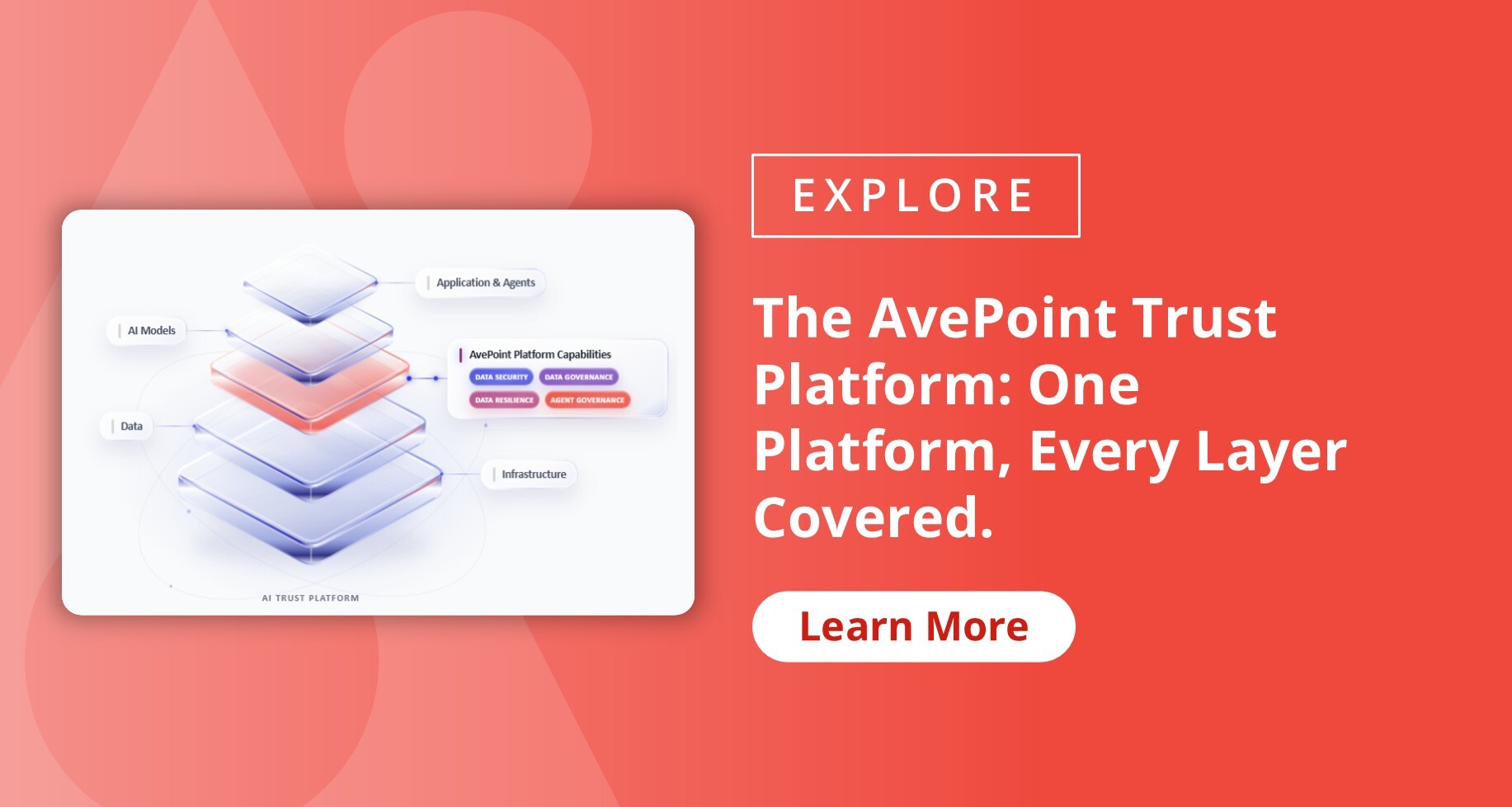
The AvePoint Trust Platform puts measurable trust into action. It helps enterprises discover shadow AI, enforce policies, manage risk, and achieve measurable trust across agents, applications, models, and vendors. Unified across environments and independent of any cloud, model, or agent, the AvePoint Trust Platform gives organizations the foundation to govern, secure, and optimize AI with confidence.
Related Questions
→ How do you build an inventory of AI agents across multiple clouds?
→ What is shadow AI, and how do you detect it?
→ What does least privilege mean for AI agents?
Frequently Asked Questions
AI safety is about whether a model behaves as intended, while AI trust is about whether an organization can prove its whole AI environment is safe to run. Safety is largely the model builder's job. Trust covers the data, agents, environments, and recovery around the model, which the deploying organization owns.
A good first step is a complete inventory of the AI agents and data sources already in use across every cloud. You can't prove control over agents you don't know exist. Once each one has a named owner, you can measure permissions, activity, and recovery against it.
Ransomware undermines AI trust because AI is only as reliable as the data it's grounded on. If attackers encrypt or corrupt that data, every agent and assistant drawing on it inherits the damage. A tested restore point, independent of the affected platform, is what lets AI resume safely.
An organization should review its AI trust posture at least quarterly, and right after any new agent deployment, vendor change, or incident. Agent counts and data access change faster than annual audit cycles, so evidence gathered once a year goes stale quickly.
AI TRiSM is Gartner's term for AI trust, risk, and security management, the category of practices and tools that keep AI reliable, secure, and compliant. Measurable Trust is AvePoint's standard for what that work should produce: independent, audit-ready evidence across data, agents, environments, and recovery.
AI trust should be owned jointly by security, governance, and IT leaders, with a single executive accountable for the outcome. Assigning it to one team recreates the silo problem the manifesto warns against. What matters is one shared standard and one shared view of the evidence.
AvePoint calls itself the AI Trust Company because its work is securing, governing, and recovering the data and agents AI depends on, independently of any AI vendor. AvePoint sells no cloud, model, or agent, so it can verify all of them to the same standard.
Organizations show regulators their AI is under control by producing records, not policies: data inventories, access logs, agent activity, and tested recovery results. Regulations increasingly expect documentation of how AI systems are governed, and evidence built up continuously is far easier to produce than evidence assembled after a request arrives.

Timothy Boettcher is a senior go-to-market and product marketing leader and Microsoft MVP for M365 Copilot, specializing in enterprise AI, data governance, and adoption strategy across global markets. He is known for translating complex technology into clear, trusted narratives that help leaders make confident decisions and drive responsible AI adoption at scale.