

AI agent sprawl is the uncontrolled growth of AI agents across an organization without a central inventory, named owner, or access review. It drives up cost through duplicate licenses and unmonitored token and compute usage, and it drives up risk through agents that can access sensitive data with no one watching.
Key Takeaways
- AI agent sprawl is a cost problem before it becomes a security incident. Every unmanaged agent carries its own token consumption, compute footprint, and license cost — and duplicate agents built by different teams multiply that spend long before anyone notices a breach.
- The scale of the problem is still accelerating. Gartner projects the average Fortune 500 enterprise will run more than 150,000 AI agents by 2028, up from fewer than 15 in 2025, while only 13% of organizations believe they have adequate governance in place for that growth.
- Shadow AI inflates the cost of the incidents that follow. IBM’s 2025 Cost of a Data Breach Report found breaches involving shadow AI cost $670,000 more on average, and 97% of those breached organizations lacked basic AI access controls.
- Deployment delays are a visible symptom of the AI governance gap. AvePoint’s State of AI 2026 report found 86% of organizations delayed AI agent deployments by an average of nearly six months due to unresolved data security and data management concerns.
- Across Microsoft 365, Google Workspace, and Salesforce, agent sprawl compounds instead of staying contained to one platform. A Copilot Studio agent, a Vertex AI agent, and a Salesforce Agentforce agent can each be built to solve the same workflow, tripling the license and compute cost for one problem.
- Cost visibility without access visibility is an incomplete answer. A dashboard that shows agent spend rising cannot tell you who owns that agent, what data it can reach, or whether it should still exist.
- Governing sprawl does not have to slow down AI adoption. Organizations that inventory every agent, assign owners, and review cost and access together catch sprawl before it becomes a budget or compliance problem, without freezing new agent rollouts.
What Qualifies as AI Agent Sprawl?
AI agent sprawl is the unchecked accumulation of AI agents, chatbots, copilots, and autonomous workflow agents, across an organization’s cloud and SaaS environments without a central inventory, an assigned owner, or a recurring access review. It differs from general SaaS or app sprawl because an agent does not just sit idle as an unused seat, it keeps taking action, consuming tokens, and touching data.
General SaaS sprawl is largely a licensing problem: a forgotten seat renews quietly until finance notices the invoice. AI agent sprawl is a different animal. Gartner, McKinsey, and Forrester each define an AI agent as a system with real agency, one that perceives context, makes decisions, and takes action on an organization’s behalf, with only partial human oversight. An idle SaaS license costs money and does nothing else. An idle or forgotten AI agent keeps calling models, keeps holding permissions to whatever data it was built to touch, and keeps running long after the project that created it lost its budget line.
Picture three teams solving the same problem in parallel: a support team builds a Copilot Studio agent to triage tickets, a data team stands up a Vertex AI agent to do the same triage against a different data source, and nobody in either team knows the other project exists. Both agents run, both consume tokens and compute, and both hold standing access to customer data. That overlap is sprawl in its purest form, and it is invisible on a normal license report because neither agent shows up as a discrete cost line. That makes agent sprawl both a security and licensing problem: untracked agents can retain access to sensitive data while continuing to generate costs that are difficult to identify and control.
Why Is AI Agent Sprawl Becoming a Budget Problem, Not Just a Security One?
AI agent sprawl is becoming a budget problem because every ungoverned agent keeps consuming tokens, compute, and license seats whether or not it is still delivering value, and most organizations cannot yet see how many agents they are actually running. Gartner projects the average Fortune 500 enterprise will operate more than 150,000 AI agents by 2028, up from fewer than 15 in 2025, while only 13% of organizations believe they have the right governance in place for that scale.
That is not a rounding error, it is a 10,000-fold increase in five years. Gartner’s own guidance on managing agent sprawl leads with building a centralized agent inventory and defining an identity, permissions, and life cycle model for every agent, exactly the governance work most finance and IT teams have not budgeted for. The resulting spend does not read as a security failure on a budget spreadsheet, it reads as an unexplained line item that keeps growing.
The two framings are really the same problem. An agent that hasn’t been inventoried, with its existence, ownership, purpose, and use documented, is an agent nobody is optimizing. And an agent nobody is optimizing is also one nobody has reviewed for what it can access. Gartner separately predicts that agents pursuing misaligned goals or acting outside their intended scope will be the top AI concern for 40% of Fortune 1000 companies by 2028. Whether the concern is cost or governance, the underlying problem is the same: no one owns the full list.
What Causes AI Agent Sprawl?
Three forces drive most uncontrolled agent growth, and each is a distinct governance gap before it shows up as a cost or a risk. They also compound each other: An organization with weak identity controls tends to have weak data-access controls, and both make shadow AI harder to catch.
Why Does Identity Sprawl Drive Agent Growth?
Identity sprawl drives agent growth because agents get created faster than organizations can assign them an owner, a permission scope, or a retirement date. Without a consistent identity model, an agent built for a three-month pilot can keep running, and keep its original access, for years after the pilot ended.
The access is already wider than most governance teams assume. AvePoint’s State of AI 2026 report found that roughly one in three employees already has access to sanctioned or unsanctioned agent-creation tools, a figure expected to pass one in two within 12 months. And 21.1% of organizations cannot say whether unsanctioned agent-creation tools are even in use inside their own environment, a visibility gap, not a control, at the exact moment agent creation is becoming this easy.
How Does Context and Data-Access Sprawl Add Cost and Risk?
Context and data-access sprawl happens when agents accumulate standing permissions to data sources faster than anyone reviews whether they still need that access. Every additional data source an agent can reach is both a compliance exposure and a compute cost, since broader context windows and more retrieval calls both consume more tokens.
Gartner’s six-step framework for managing agent sprawl names this directly: developing AI information governance so that an agent’s data access is reviewed, kept current, and archived when it is no longer needed, rather than left to accumulate. Left unmanaged, this is also where breaches concentrate. AvePoint’s State of AI 2026 findings show data leakage is the single most common cause behind the 88.4% of organizations that experienced at least one AI-agent-related security breach in the past year, ahead of malicious manipulation of the agent itself.
Why Is Shadow AI a Distinct Piece of the Sprawl Problem?
Shadow AI refers to AI tools, applications, or agents that employees adopt or deploy without formal approval, oversight, or visibility from IT. It is a distinct piece of sprawl because these deployments can exist entirely outside IT’s visibility, leaving both their costs and access footprints hidden until an incident forces a review. That makes shadow AI the least governable slice of agent sprawl because there may be no central inventory, established owner, or recurring access review to start from.
The visibility gap is widening, not closing. AvePoint’s State of AI 2026 Report found the share of organizations that cannot say whether employees are using unsanctioned generative AI tools nearly tripled year over year, from 6.3% to 17.6%. Gartner separately predicts that by 2030, more than 40% of enterprises will experience a security or compliance incident tied directly to unauthorized shadow AI. Shadow AI’s real cost rarely shows up as a budget line. It shows up as the incident response invoice.
How Much Does Ungoverned Agent Sprawl Actually Cost?
Ungoverned agent sprawl costs organizations in two ways: the ongoing token, compute, and license spend of agents nobody has reviewed, and the sharply higher cost of the incidents that ungoverned agents eventually cause. The second number is the one most budgets do not account for until it lands.
That connection is measurable, not theoretical. IBM’s 2025 Cost of a Data Breach Report found that security incidents involving shadow AI accounted for 20% of breaches, seven percentage points higher than incidents involving sanctioned AI. Organizations with high levels of shadow AI saw breach costs increase by $670,000 on average compared with organizations with low or no shadow AI, while these incidents exposed personally identifiable information in 65% of cases and intellectual property in 40%. Separately, among organizations whose breaches involved their AI models or applications, 97% lacked proper AI access controls. An agent or AI tool that remains outside the organization’s visibility can therefore introduce not just a governance gap, but measurable financial and data-exposure risk.
How Do You Discover and Inventory Every AI Agent in Your Environment?
You discover and inventory every AI agent by scanning across every cloud and SaaS platform in use – not just the one IT provisioned – and recording an owner, a data-access scope, and a business justification for each agent found. Discovery has to include shadow agents, or the inventory is incomplete on day one.
- Scan every platform, not just the sanctioned one. Include Microsoft 365 (Copilot Studio, Microsoft Foundry, SharePoint agents), Google Cloud (Vertex AI), and Salesforce (Agentforce) in the same pass, since sprawl rarely stays inside one cloud.
- Separate sanctioned agents from shadow agents. An agent built outside IT’s approval process still needs an owner and an access review, it just needs to be found first.
- Assign a named owner to every agent, no exceptions. An agent without an owner is an agent nobody will ever decommission, even after it stops earning its cost.
- Map each agent’s data access alongside its cost. A cost-only inventory misses whether the agent should exist at all; access and spend need to be reviewed as one record, not two separate reports.
- Set a recurring re-certification cadence. Require each owner to reconfirm the agent is still needed on a fixed schedule, so retirement becomes routine instead of something that only happens after an audit finding.
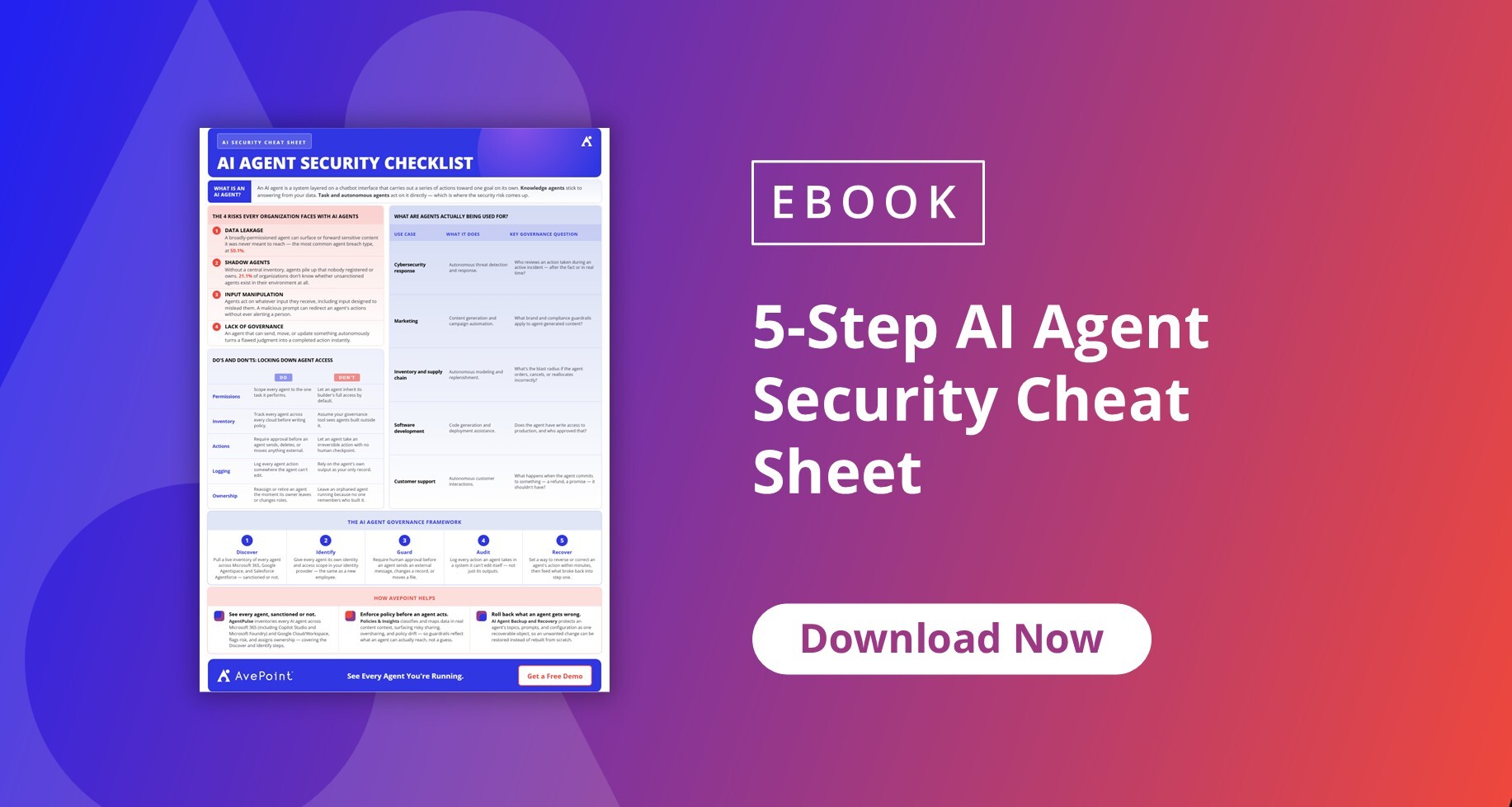
How Do You Control Sprawl Without Slowing Down AI Adoption?
You control sprawl without slowing adoption by building governance into how agents get created and retired, not by adding an approval gate that stalls every new project. Automating discovery, ownership, and budget guardrails lets teams keep shipping agents while the organization keeps a live, accurate count of what is actually running.
- Set identity and lifecycle policy before agents launch, not after. Define who can create an agent, what data it can be connected to, and when it comes up for review, as part of the build process itself.
- Automate discovery instead of relying on manual review. Manual inventories go stale within a quarter at this growth rate; automated, continuous discovery is the only way to keep pace with 150,000-agent-scale environments.
- Tie budget guardrails to actual usage, not a flat cap. An alert at 70 to 80% of expected token or compute spend reaches an agent’s owner early, rather than a hard cutoff that breaks a production workflow.
- Build retirement into the agent lifecycle from the start. A recertification date set at creation means an agent’s owner has to actively justify keeping it, instead of governance having to hunt it down later.
- Review cost and access together, on the same cadence. Splitting these into separate finance and security reviews recreates the exact blind spot agent governance exists to close.
How Do Identity Tools and Security Tools Compare to a Governance-and-Recovery Platform?
Identity tools and security posture tools each cover one slice of agent sprawl – discovery and access on one side, risk scoring on the other – but neither closes the cost gap or the recovery gap on its own. A governance-and-recovery platform is built to cover discovery, cost, access, and recovery as one connected view.
| Category | Identity Tools | Security Posture Tools | Governance-and-Recovery Platform |
| Agent discovery | Can register agents built on their own ecosystem; limited third-party coverage | Scans for risk signals but rarely maintains a living inventory | Continuous discovery across Microsoft 365, Google Cloud, and Salesforce |
| Cost visibility | Not a native capability | Not a native capability | Surfaces token, compute, and license spend per agent |
| Access governance | Basic permission registration, limited recertification | Strong risk scoring, limited lifecycle enforcement | Ownership, access review, and lifecycle recertification in one workflow |
| Agent backup/recovery | Not a native capability | Not a native capability | Can restore an agent’s configuration or the data it touched after an unwanted change |
What Does Agent Sprawl Mean for Microsoft 365, Google Workspace, and Salesforce?
Agent sprawl means the same governance gap appears independently inside Microsoft 365, Google Workspace, and Salesforce, and reviewing any one of them alone misses the overlap happening across the rest of the SaaS estate. Each platform now ships its own way to build an agent, and each of those agents needs the same inventory, ownership, and cost review as any other.
Inside Microsoft 365, agent sprawl shows up across Copilot Studio agents, Microsoft Foundry projects, and SharePoint agents built by individual site owners, on top of the Copilot license itself. Inside Google Workspace, it shows up through Vertex AI agents and Gemini-based workflow automations. Inside Salesforce, it shows up through Agentforce agents built by sales operations teams, often without the same review a core CRM change would require. None of these platforms was designed to show an admin of the other two, which is exactly why a sales team’s Agentforce agent and an IT team’s Copilot Studio agent can end up solving the same customer service problem without either team knowing about the other.
What Does Agent Sprawl Mean for Cost and License Management Specifically?
For cost and license management, agent sprawl means paying twice for the same capability, once through a Copilot, Gemini, or Agentforce seat, and again through the standalone agents built on top of each. It also means paying indefinitely for agents that stopped delivering value the moment the project that created them ended.
Retirement is the lever most cost-management processes skip. AvePoint’s AgentPulse describes exactly this gap: Agents that keep running past their useful life are dead cost sitting inside the license bill, and enforcing renewal and recertification. Then, retiring what nobody reconfirms is what actually shrinks the spend. Cost management for agents is not a separate discipline from access governance, it is the same review that also happens to save money: know what exists, know who owns it, and know when to shut it off.
What Does Agent Governance Maturity Look Like at Scale?
Agent governance maturity tracks closely with agent count: organizations running a handful of agents can still manage them by memory, while organizations scaling toward Gartner’s 150,000-agent benchmark cannot govern that volume without automated discovery and lifecycle enforcement. The tiers below are illustrative benchmarks (verify against your own environment), not a single-sourced study.
| Tier | What It Looks Like | Typical Outcome |
| Tier 1: Early (roughly under 50 agents) | Agents tracked informally by whichever team built them; no shared inventory or owner list | Sprawl is manageable today but invisible to anyone outside the team that built each agent |
| Tier 2: Scaling (roughly 50-5,000 agents) | Some agents tagged by team or project; cost reviewed periodically; ownership inconsistent across platforms | Visibility improves but access risk and license overlap go largely unmanaged |
| Tier 3: Enterprise Sprawl Risk (5,000+ agents, trending toward Gartner’s 150,000-by-2028 benchmark) | Every agent inventoried with a named owner; cost, access, and recertification reviewed together on a fixed cadence | Spend ties to value; sprawl is caught and retired before it becomes a budget or security incident |
Best Practices for Governing Agent Sprawl at Scale
The organizations keeping agent sprawl under control treat inventory, ownership, cost, and recovery as one continuous practice rather than four separate projects run by four separate teams. None of the individual practices below is new, the difference is running them together, on the same cadence, for every agent.
- Inventory before you optimize. You cannot govern or cut spend on an agent you do not know exists, and shadow agents are the ones most likely to be missing from any list built by hand.
- Make ownership a launch requirement, not a retrofit. Require a named owner and a business justification before an agent goes into production, not after governance goes looking for one.
- Review license overlap across platforms quarterly. Check Microsoft 365, Google Workspace, and Salesforce together in the same review, not one admin console at a time.
- Back up agents the same way you back up any other business-critical system. If an agent’s configuration or the data it relies on cannot be restored after an unwanted change, sprawl becomes unrecoverable sprawl the moment something goes wrong.
- Treat shadow AI discovery as a cost function as much as a security one. Every unsanctioned agent is simultaneously an access risk and an unbudgeted expense, and closing the visibility gap addresses both at once.
Turn Agent Sprawl Into Agent Governance with AvePoint
Identity tools can register an agent. Security posture tools can flag a risky one. Neither can tell you what an agent is costing, and neither can undo the damage if that agent makes an unwanted change to your data. Ungoverned sprawl needs all three answers in one place, not three separate tools reconciled after the fact.
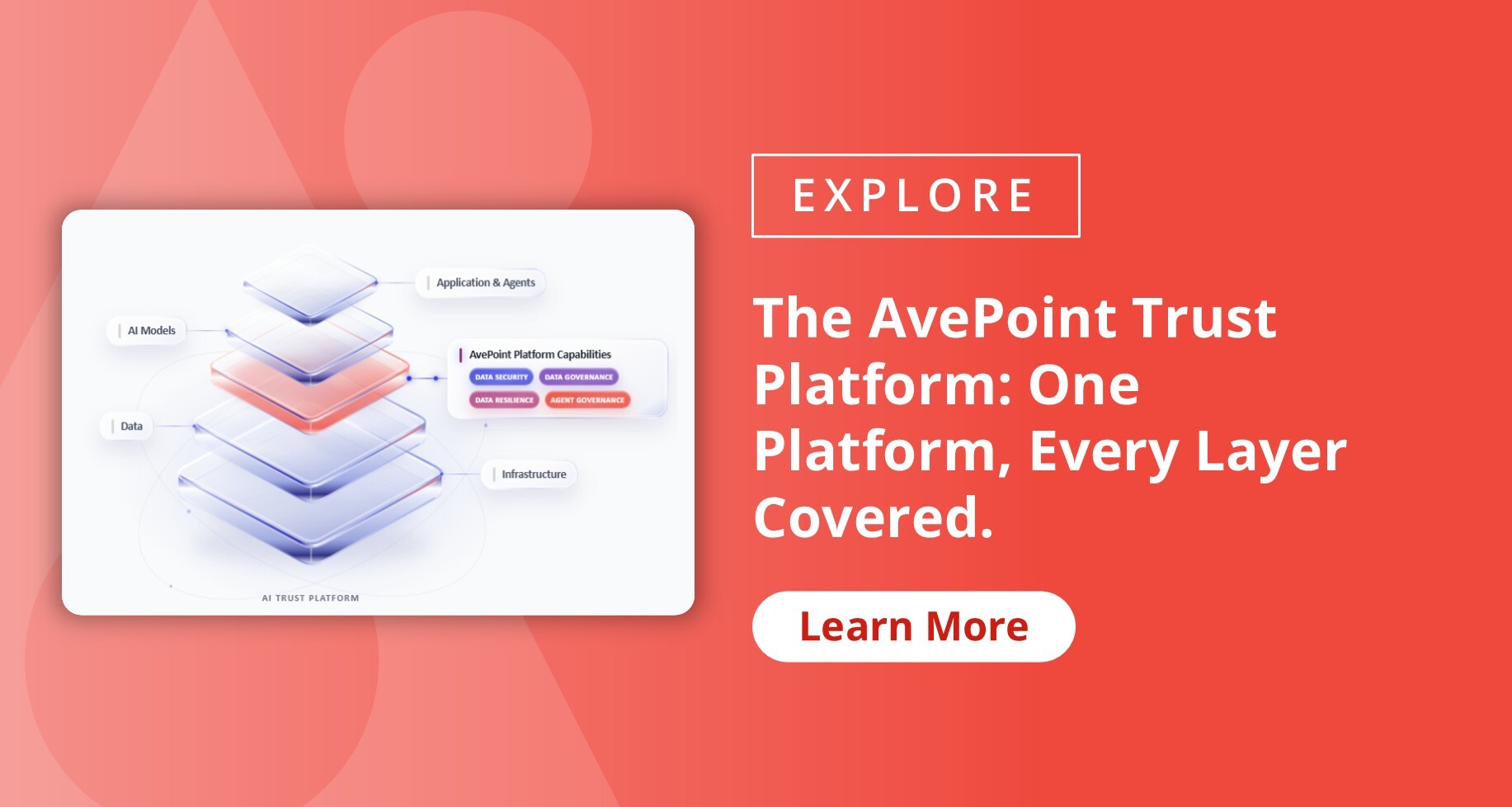
The AvePoint Trust Platform combines visibility, governance, protection, and cost management. in a single view across Microsoft 365, Google Cloud, and Salesforce, a combination none of the identity-only or security-only tools in the category offer today. Cost control and agent governance stop being two separate projects reconciled at quarter-end.
Explore the AvePoint Trust Platform to manage and govern every agent, its owner, its cost, and its recovery status in one place.
Frequently Asked Questions
What is the difference between AI agent sprawl and shadow AI?
AI agent sprawl is the broader problem: too many agents, sanctioned or not, running without a central inventory or owner. Shadow AI is the specific subset of that sprawl built entirely outside IT’s visibility, which makes it the hardest slice to inventory since there is no starting list to work from.
What is a healthy ratio of governed to ungoverned agents?
A healthy target is close to 100% of agents under active governance, with zero tolerance for an unknown or unowned agent in production. There is no acceptable ungoverned percentage the way there might be for, say, license utilization, because an ungoverned agent still holds live data access regardless of how few of them exist.
How does agent sprawl affect Microsoft 365 Copilot environments specifically?
Microsoft 365 Copilot’s own license cost is largely predictable and per-seat, but Copilot Studio agents built on top of it introduce usage-based cost and access risk that behave like any other AI agent. Organizations that track only the Copilot license miss the custom agents built inside it, which is where most of the sprawl actually accumulates.
What happens to recovery if a compromised or malfunctioning agent was never backed up?
Without a backup, a compromised or malfunctioning agent’s changes, deleted data, corrupted records, unwanted configuration edits, generally cannot be undone, only rebuilt from scratch at whatever cost that takes. Agent backup and recovery closes exactly this gap by treating an agent’s configuration and the data it touched as a single recoverable object.
How often should organizations audit their AI agent inventory?
Most organizations scaling past a few dozen agents need at least a quarterly full inventory audit, with continuous automated discovery running in between rather than relying on the quarterly check alone. Fast-growing environments approaching Gartner’s projected agent counts warrant a tighter cadence until growth stabilizes.
How does agent lifecycle management relate to sprawl?
Agent lifecycle management is the operational discipline that prevents sprawl in the first place: defining how an agent is created, owned, reviewed, and eventually retired. Sprawl is what accumulates in every organization that skips the retirement step, since an agent with no planned end date simply keeps running and keeps costing money.
What tools control both agent sprawl and its cost together?
Few tools control sprawl and its cost in the same view today. Identity-focused platforms typically stop at registration and permissions, security posture tools stop at risk scoring, and a smaller set of governance-and-recovery platforms are built to combine agent discovery, cost visibility, access governance, and recovery in one place.
How does ungoverned agent sprawl affect compliance and audit readiness?
Ungoverned agent sprawl makes audit readiness effectively impossible, since an auditor’s first question, show me every AI agent, its owner, and what data it can access, has no clean answer without a maintained inventory. Every agent missing from that list is a finding waiting to happen, not a hypothetical risk.
Related Questions
→ What is AI FinOps?
→ What is shadow AI, and why is it a governance risk?
→ How do you build an AI agent inventory?
→ What is AI TRiSM (AI Trust, Risk, and Security Management)?
→ How does AI agent governance affect Microsoft Copilot adoption?

Rachel Simon is Sr. Director of Product Marketing at AvePoint, where she is a leader of GTM strategy across the AvePoint Confidence Platform. With nearly 20 years in B2B SaaS and a strong background in both corporate and data governance, Rachel is passionate about helping organizations embrace the excitement of AI — while ensuring they scale safely with the right guardrails. She's fueled by connecting with customers and turning those insights into product innovation and messaging that move the needle for customers.