How to Secure Every Layer of Your Cloud Infrastructure
Use this practical cheat sheet to protect identity, databases, storage, DevOps, and compute through a framework for prevention, detection, recovery, and compliance.
eBook
How to Secure Every Layer of Your Cloud Infrastructure
A single weakness in identity, configuration, compute, or the software supply chain can create risk across connected cloud systems.
What's Inside
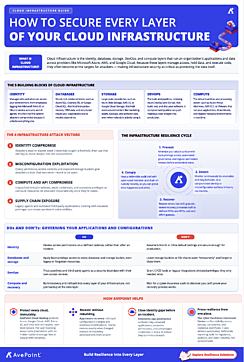
Cloud infrastructure spans the systems that control access, store information, build software, and run critical workloads. This cheat sheet breaks down:
- The five building blocks of cloud infrastructure: Identity, databases, storage, DevOps, and compute, with examples across Microsoft Azure, AWS, Google Cloud, and VMware.
- Four common attack vectors: Identity compromise, misconfiguration exploitation, compute and API compromise, and supply chain exposure.
- A repeatable infrastructure resilience cycle: Prevention, detection, recovery, and compliance before and after an incident.
- Layer-specific dos and don'ts: Straightforward guidance for access, configurations, databases and storage, DevOps pipelines, compute, and recovery.
What You'll Learn
- Identify the five infrastructure layers that support your applications, data, AI workloads, and recovery environments.
- Recognize risks from compromised identities, exposed configurations, vulnerable compute resources, and outdated third-party tools.
- Apply practical controls for least-privilege access, permission reviews, resilient pipelines, and tested recovery.
- Build a repeatable resilience cycle that connects prevention, detection, recovery, and compliance.
Build Resilience Into Every Layer of Your Cloud
Protecting cloud data is only part of the job. AvePoint helps organizations strengthen resilience across identity, data, applications, and recovery with immutable multicloud backup, full-fidelity recovery, enterprise application governance, centralized visibility, and audit-ready reporting.
Frequently Asked Questions
What is cloud infrastructure security?
Cloud infrastructure security is the protection of the identity, database, storage, DevOps, and compute layers that run an organization’s applications and data across cloud providers. It combines access controls, configuration governance, monitoring, recovery, and compliance practices across the environment.
What are the main cloud infrastructure attack vectors?
The four attack vectors covered in this cheat sheet are identity compromise, misconfiguration exploitation, compute and API compromise, and supply chain exposure. Each can give attackers a path into connected applications, data, or production systems.
How can organizations improve cloud infrastructure resilience?
Organizations can improve resilience by reducing the attack surface, continuously detecting anomalies and risky behavior, testing granular recovery processes against defined recovery objectives, and maintaining defensible audit trails. AvePoint supports this approach with multicloud backup, full-fidelity recovery, application governance, centralized visibility, and audit-ready reporting.