
How To Build Trust In Your Digital Identities: A Framework for Visibility and Accountability
Transform identity trust into a clear, repeatable discipline with five essential actions.
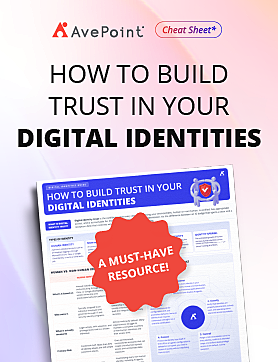
Cheat Sheet
How To Build Trust In Your Digital Identities: A Framework for Visibility and Accountability
As AI agents and automation expand, every identity must be visible — and every action accountable.
What's Inside
Identity trust extends beyond authentication. It requires organizations to understand who or what has access, verify that access remains appropriate, assign ownership, protect critical identity configurations, and continuously monitor risk.
This cheat sheet includes:
- A clear definition of digital identity trust and its impact on modern data protection.
- Key concepts and terms, from human to non-human identities, service principals, and AI agents.
- A breakdown of visibility and governance challenges across identity types.
- A five-part trust framework built on discovery, verification, governance, protection, and monitoring.
- A side-by-side look at manual versus AvePoint-supported governance covering visibility, ownership, access control, recovery, and AI risk.
What You'll Learn
- Identify every active identity: human, service principal, and AI agent.
- Validate identity use and ensure boundaries remain approved.
- Govern ownership and permissions through accountable, least-privilege access.
- Protect configurations and monitor identity activity as environments evolve.
Build Visibility and Accountability Across Every Identity
Identity trust now spans far beyond employee accounts. Service principals, workload identities, and AI agents often hold broad permissions, sometimes without clear ownership. Organizations need a consistent, governed way to establish visibility, accountability, and oversight across every identity.
Download the cheat sheet to learn how to operationalize identity trust and see how AvePoint enables stronger visibility into AI agents, enhanced governance, and lasting accountability throughout the identity lifecycle.
Frequently Asked Questions
1. What is digital identity trust?
Digital identity trust is the confidence that every identity in your environment, human or non-human, is verified, has appropriate access, and is accountable for its actions. It goes beyond authentication and permissions.
2. Why are non-human identities and AI agents harder to govern?
Service principals, workload identities, and AI agents often hold broad permissions without a clear owner. Ownership usually stays with whoever built the integration and is rarely reviewed again. That creates visibility and accountability gaps that human-focused identity programs don't cover.
3. How can organizations build trust across every identity?
Organizations need a repeatable framework built on discovery, verification, governance, protection, and continuous monitoring. The cheat sheet explains how to put each of these into practice.
More Similar Resources to Explore



M365 Security Essentials: Safeguarding Your EntraID and Power Platform Data
Oct 31, 2024