

As managed service providers (MSPs) help customers navigate AI adoption, evolving security requirements, and increasingly complex Microsoft 365 and Azure environments, visibility and control have never been more important. The August AvePoint Elements release introduces new capabilities that help partners govern AI agents, streamline workspace provisioning, strengthen security management, improve user and subscription administration, and optimize Azure operations at scale.
From centralized AI agent discovery and governance to Azure policy-aligned security assessments, staged application deployments and approval workflows, and automated Azure Virtual Desktop scaling, these enhancements help partners deliver more efficient, secure, and scalable managed services across customer environments.
Platform Administration
New platform enhancements give partners greater flexibility in managing customer subscriptions across shared environments. Administrators can now configure pooled subscription behavior at the individual customer level, allowing automatic or manual seat adjustments based on customer needs without affecting subscription management settings for other customers.
Workspace Management
As customers expand their use of Microsoft 365 Copilot, Copilot Studio, SharePoint agents, and other AI-powered solutions, maintaining visibility and governance across growing AI ecosystems becomes increasingly challenging. This release introduces new capabilities that help partners manage both workspaces and AI adoption more effectively.
AI Agent Management provides a centralized multitenant dashboard for discovering, monitoring, and optimizing AI agents across customer environments. Partners can gain visibility into agent ownership, activity, adoption trends, usage patterns, and data access, helping identify governance gaps, optimize AI investments, and support compliance initiatives. By bringing workspace and AI visibility together, partners can better support customers as AI adoption grows while creating opportunities for ongoing AI governance and advisory services.
Administrators can also now predefine Teams channels and folder structures within provisioning templates, making it easier to create consistent workspaces at scale. By automatically applying these configurations during deployment, organizations can standardize workspace creation, reduce manual effort, and improve consistency across customer environments.
User Management
New Membership Tracking, Group Member Synchronization, and Predefined Reports capabilities help administrators better manage user access across customer environments. Administrators can monitor membership changes, identify discrepancies, review synchronized relationships, and schedule reports to strengthen governance, reporting, and access management across customer environments.
Azure Security Management and Baseline Management
Elements continues to expand security capabilities with tighter alignment to industry standards and best practices. Azure Policy integration introduces access to more than 1,700 built-in security rules aligned with Azure Policy, helping administrators assess configurations, identify risks, and maintain a security posture consistent with native Azure security recommendations.
The new Catalog section in Baseline Management provides a centralized repository of supported configurations with built-in CIS and NIST references. Expanded configuration coverage, granular permissions, and new baseline creation options help administrators validate requirements, accelerate deployments, and standardize security and compliance settings across customer environments.
App Management and Workflows
New staged deployment and approval workflow capabilities give administrators greater control over how application updates are validated and rolled out. Approval stages can be configured, reviewers assigned, and decisions tracked to support more consistent deployments across tenants. Built-in approval, rejection, reversion, and termination actions provide clear governance throughout the deployment lifecycle.
Azure Virtual Desktop
Partners can manage Azure Virtual Desktop environments more efficiently with new automation and provisioning enhancements. Host pool auto scaling dynamically adjusts session host capacity based on demand, helping balance performance and cost efficiency.
FSLogix profile setup simplifies deployment by enabling administrators to configure profile settings, storage locations, and agent versions during host pool provisioning, reducing manual configuration and accelerating deployment.
Want to Explore These Capabilities in More Detail?
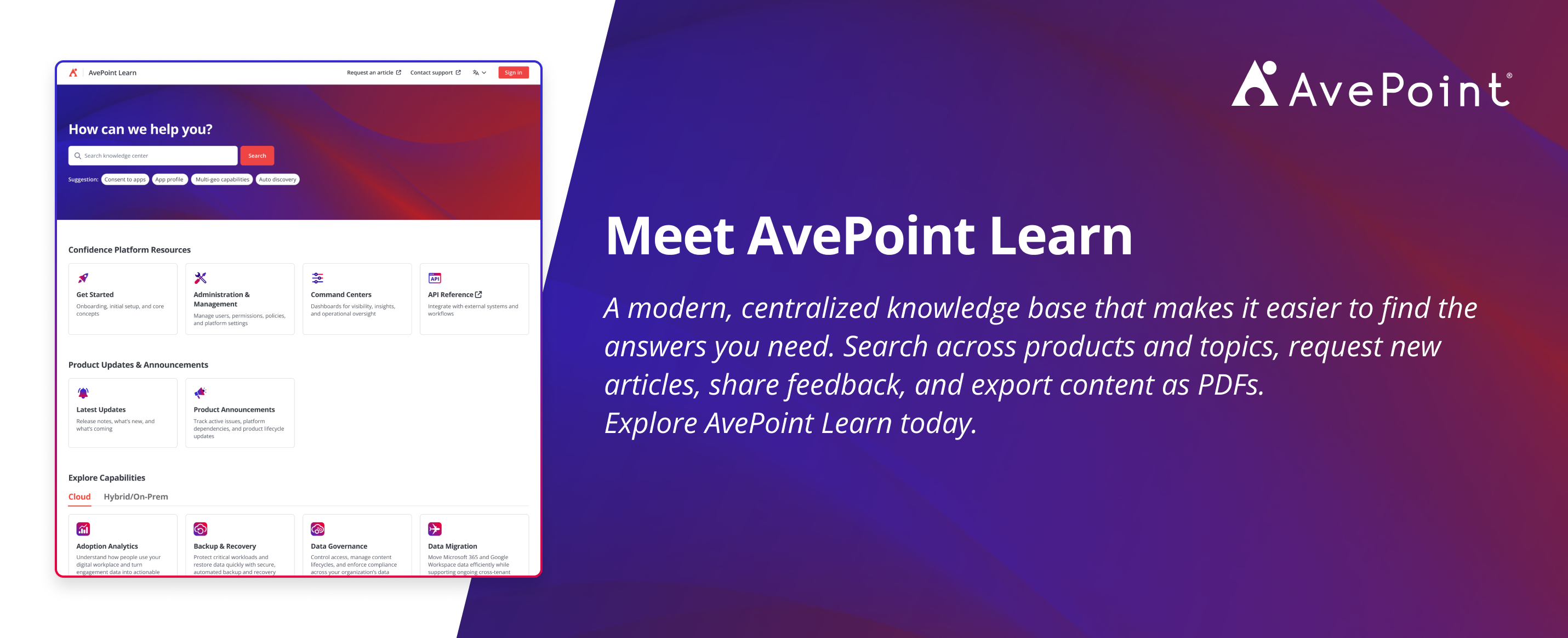
Visit AvePoint Learn to access product documentation, release notes, and deployment guidance. Whether you're helping customers govern AI adoption, strengthen security, optimize Azure resources, or standardize workspace management, the latest AvePoint Elements innovations provide the visibility and control needed to deliver scalable managed services with confidence.

Esther is AvePoint's Director of Technical Writing, with a specialization in communicating product updates and platform updates.