
Key Takeaways
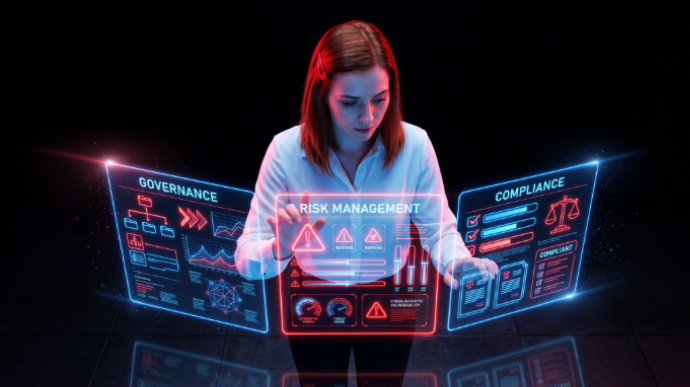
- GRC stands for governance, risk and compliance: Governance sets direction and accountability, risk management identifies and treats threats, and compliance proves obligations are met.
- A GRC framework such as COSO ERM, ISO 31000, NIST CSF 2.0 or the NIST AI RMF gives the program one shared structure for controls and evidence.
- IT GRC and GRC in cybersecurity apply the same model to systems, identities and data, including content in Microsoft 365, Google Workspace and Salesforce.
- AI GRC treats AI models and AI agents as governed assets with owners, access limits, audit trails and recovery plans.
- Continuous compliance replaces point-in-time audits with automated monitoring and evidence that updates as the environment changes.
Every regulated organization runs some form of governance, risk and compliance, whether it calls it GRC or not. The difference between a mature program and a fragile one is integration: shared policies, shared controls and shared evidence. This guide explains what GRC means, how a GRC framework works, which GRC tools support it and how AI agents change what GRC must cover.
What Is GRC? The Meaning of Governance, Risk and Compliance
GRC is an integrated operating model that connects three disciplines organizations once ran separately. Governance defines who decides and how. Risk management identifies what could prevent the organization from meeting its objectives. Compliance demonstrates that the organization follows the laws, regulations, standards and internal policies that apply to it. In a GRC program, all three share one set of policies, one control library and one body of evidence.
What GRC Stands For: A Short Definition
GRC stands for governance, risk and compliance. The term describes both a discipline and a category of technology. As a discipline, GRC is the coordinated management of direction, uncertainty and obligations. As a technology category, GRC tools and GRC software provide risk registers, policy workflows, control testing and reporting that support the discipline.
Where the GRC Framework Came From
The modern concept took shape in the early 2000s. The Sarbanes-Oxley Act of 2002 required U.S. public companies to document and test internal controls over financial reporting, which pushed governance, risk and compliance teams to share evidence. OCEG, a nonprofit founded in 2002, popularized the GRC term and described it as the integrated capabilities that help an organization reliably achieve objectives, address uncertainty and act with integrity. COSO published its Enterprise Risk Management framework in 2004 and updated it in 2017.
Why GRC Matters More in the AI Era
AI changes the scope of GRC because AI systems read, generate and act on enterprise data at machine speed. A copilot can surface an overshared file in seconds. An AI agent can call tools, change records and trigger workflows without a person approving each step. According to the World Economic Forum's Global Cybersecurity Outlook 2026, 87% of respondents identified AI-related vulnerabilities as the fastest-growing cyber risk over the course of 2025. GRC programs that govern only people and applications now leave a material gap.
Governance vs. Risk vs. Compliance: The Three Pillars of GRC
The three pillars answer different questions, but each depends on the others. A practical shorthand is say it, do it, prove it: Governance says what should happen, risk management decides where to act first, and compliance proves the controls worked.
Governance: Policies, Roles and Decision Rights
Governance establishes the rules, roles and accountability structures that direct an organization. It includes board oversight, policy ownership, decision rights, risk appetite statements and escalation paths. In IT, governance also covers data ownership, workspace lifecycle rules and approval processes for new applications and AI agents. For how these rules run day to day, see operational governance.
Risk Management: Identify, Assess, Treat and Monitor
Risk management identifies events that could affect objectives, assesses their likelihood and impact, and selects a treatment: mitigate, transfer, accept or avoid. Results are recorded in a risk register with named owners and review dates. Mature programs track key risk indicators continuously rather than reassessing once a year.
Compliance: Laws, Regulations, Standards and Internal Policy
Compliance maps external obligations and internal policies to specific controls, then tests and documents those controls. Typical obligations include data privacy laws, financial reporting rules, sector regulations and contractual requirements. The output is evidence that auditors, regulators and boards accept.
Table 1. Governance vs. Risk vs. Compliance at a Glance
| Pillar | Core Question | Key Activities | Typical Owner | Evidence Produced |
|---|---|---|---|---|
| Governance | Who decides, and how? | Policies, roles, decision rights, risk appetite | Board, executive team, CIO | Approved policies, charters, ownership records |
| Risk Management | What could go wrong, and how much does it matter? | Identify, assess, treat and monitor risk | Chief risk officer, CISO | Risk register, key risk indicators, treatment plans |
| Compliance | Can we prove we meet our obligations? | Obligation mapping, control testing, reporting | Chief compliance officer, internal audit | Control evidence, audit reports, attestations |
| Integrated GRC | Are direction, risk and proof aligned? | Shared control library, continuous monitoring | GRC leader with cross-functional owners | One evidence trail mapped to multiple frameworks |
Types of GRC: IT GRC, GRC in Cybersecurity and Data Governance Compliance
Enterprise GRC
Enterprise GRC covers strategic, financial, operational, legal and reputational risk across the whole organization. It typically connects enterprise risk management (ERM), internal audit, ethics programs and third-party risk management under one reporting structure.
IT GRC and GRC in Cybersecurity
IT governance, risk and compliance (IT GRC) applies the GRC model to technology. It defines who owns IT and security decisions, assesses cyber and operational risk to systems and data, and maps technical controls to frameworks such as ISO/IEC 27001, NIST CSF 2.0 and SOC 2. GRC in cybersecurity is the security-focused subset. It links threat and vulnerability data to the risk register so security investment follows business priority rather than tool coverage.
Data Governance Compliance and GRC in Microsoft 365
Much of an organization's regulated information now lives in collaboration platforms such as Microsoft 365, Google Workspace and Salesforce. Data governance compliance applies GRC controls directly to that content: classification and sensitivity labels, permissions and sharing, retention and disposition, and data residency. In Microsoft 365, native capabilities such as Microsoft Purview Compliance Manager provide control assessments and recommended improvement actions. Organizations that run several clouds still need one consistent policy model and one evidence trail across all of them.
AI GRC: AI Governance, Risk and Compliance for Models and Agents
AI GRC applies governance, risk and compliance to AI systems themselves. It covers model inventory and approval, training and grounding data, acceptable use, output monitoring and alignment with the EU AI Act, ISO/IEC 42001 and the NIST AI Risk Management Framework. AI GRC is distinct from using AI to automate GRC tasks, although many programs now do both. For the broader discipline, see AI governance.
Common GRC Frameworks and Standards
A GRC framework provides a shared structure for policies, controls and evidence, and most organizations combine several. AI-specific standards are entering that mix quickly. The Stanford HAI 2026 AI Index Report found that 36% of surveyed organizations cited ISO/IEC 42001 as an influence on their responsible AI practices, and 33% cited the NIST AI Risk Management Framework.
Table 2. GRC Framework Comparison: Scope, Best Use and AI Coverage
| Framework | Scope | Best For | AI Coverage |
|---|---|---|---|
| OCEG GRC Capability Model | Integrated GRC capabilities | Designing an end-to-end GRC program | Indirect |
| COSO ERM (2017) | Enterprise risk, strategy and performance | Board-level risk oversight and internal control | Indirect |
| ISO 31000 | Risk management principles and process | A common risk vocabulary across functions | Indirect |
| ISO/IEC 27001 | Information security management system | Certifiable security controls for IT GRC | Partial |
| NIST CSF 2.0 | Cybersecurity outcomes, including the Govern function | GRC in cybersecurity and board reporting | Partial |
| ISO/IEC 42001 | AI management system | Certifiable AI governance | Direct |
| NIST AI RMF | AI risk: Govern, Map, Measure and Manage | AI governance, risk and compliance programs | Direct |
Regulations That Shape GRC Programs
Regulations define the obligations a GRC program must prove. Common examples include GDPR, CCPA and HIPAA for privacy; the Sarbanes-Oxley Act and SEC cybersecurity disclosure rules for financial reporting; DORA and NIS2 for operational resilience and incident reporting in the EU; and the EU AI Act for AI systems. DORA and NIS2 expect organizations to show that critical services and data can be restored, which makes backup and recovery evidence part of compliance. Learn more about cyber resilience.
GRC for AI Agents: Governing Non-Human Actors
AI agents are software entities that plan and take actions toward a goal, often with delegated permissions. From a GRC perspective, each agent is a new actor that needs the same controls as a privileged user. Core controls include:
- Inventory: Discover sanctioned and unsanctioned agents, the models they use, and the tools and data they connect to.
- Ownership: Assign a named person who is accountable for each agent's purpose and behavior.
- Least-privilege access: Scope agent permissions to the business purpose and remove them when that purpose ends.
- Policy enforcement: Apply retention, residency and sensitivity rules to agent inputs and outputs.
- Audit evidence: Log every agent action in a form auditors and regulators can query.
- Recoverability: Restore data, configurations or permissions an agent changed to a known-good point.
Without these controls, agents inherit existing oversharing and permission sprawl and then amplify it at machine speed.
How to Build a GRC Program: 7 GRC Best Practices
- Inventory assets, data, identities and AI agents. A program cannot govern what it cannot see.
- Define governance roles and risk appetite. Assign owners for policies, risks and controls, and set tolerance thresholds the board approves.
- Map obligations to one control library. Link each regulation and standard to shared controls so one test satisfies several frameworks.
- Assess and prioritize risk. Score risks by likelihood and impact, and focus remediation on the most exposed data and systems.
- Automate policy enforcement. Apply permissions, labels, retention and lifecycle rules programmatically rather than through manual requests.
- Monitor controls continuously. Replace annual sampling with automated control checks and alerts when a control drifts.
- Report and prove it. Give boards and auditors metrics drawn from the environment itself, such as exposure closed, content labeled and agents governed.
From Periodic Audits to Continuous Compliance
Continuous compliance validates controls automatically and constantly rather than only at audit time. It relies on direct integration with source systems, automated evidence collection and real-time alerts. The result is shorter audit preparation, fewer findings and evidence that reflects the current state of the environment instead of a past snapshot.
How to Evaluate GRC Tools and GRC Software
GRC software ranges from enterprise GRC suites that manage registers, policies and attestations to specialized tools that enforce controls inside specific platforms. Many organizations use both. When evaluating GRC tools, assess the following criteria:
- Coverage: Does it reach every environment where regulated data and AI agents live, including Microsoft 365, Google Workspace and Salesforce?
- Enforcement: Can it apply controls directly, or does it only record that controls exist?
- Evidence: Does it collect audit-ready evidence automatically and map it to frameworks?
- AI readiness: Can it discover, inventory and govern AI agents and their data access?
- Resilience: Can it prove data and configurations are recoverable, as DORA and NIS2 expect?
- Integration: Does it feed findings into the enterprise GRC suite and risk register?
Conclusion: Turning GRC Policy Into Evidence
Governance, risk and compliance gives organizations one way to set direction, manage uncertainty and prove they meet their obligations. As copilots and AI agents act on enterprise data, GRC must move beyond documents and annual audits to controls that are enforced and evidenced where data, permissions and agents actually live.
AvePoint, the AI Trust Company, brings 25 years of experience governing demanding data environments to this challenge. The AvePoint Trust Platform helps enterprises discover their AI, enforce policy and manage risk across agents, applications, models and data in Microsoft 365, Google, Salesforce and other cloud environments. It complements enterprise GRC suites by helping organizations turn policy into evidence auditors and boards accept: governed data, least-privilege access, enforceable policy, audit evidence and recoverability across the entire AI estate. Because trust is an outcome, not a belief, AvePoint helps organizations govern, secure and optimize AI so they can deploy AI with confidence and innovation scales without scaling risk.

Automate Governance, Risk and Compliance Across Your Data Estate
Put the say it, do it, prove it model into practice. AvePoint Compliance Guardian automates data discovery, classification and risk management across the enterprise data estate. Run risk-based assessments, scan content against more than 150 built-in checks, take protective actions such as quarantine, redaction or encryption, and track incidents to resolution with reporting that demonstrates compliance.
Frequently Asked Questions
GRC is an integrated approach to governance, risk and compliance that connects how an organization is directed, how it manages risk and how it meets its obligations. Instead of running in separate departments, the three disciplines share policies, controls and evidence. A mature GRC program gives leaders decisions they can defend to auditors, regulators and boards.
Governance means the rules, roles and decision rights that direct an organization. Risk means identifying, assessing and treating anything that could prevent it from meeting its objectives. Compliance means proving the organization follows applicable laws, regulations, standards and internal policies.
IT governance, risk and compliance, or IT GRC, applies the GRC model to technology systems, identities and data. It assigns ownership of IT and security decisions, assesses cyber and operational risk, and maps controls to frameworks such as ISO/IEC 27001 and NIST CSF 2.0. GRC in cybersecurity is a closely related subset focused on security controls and threat-informed risk decisions.
GRC tools and GRC software manage risk registers, policies, control testing, audit workflows and compliance reporting. Some tools also enforce controls directly inside platforms such as Microsoft 365, Google Workspace and Salesforce. Organizations often combine an enterprise GRC suite with specialized tools that supply continuous compliance evidence from the data itself.
AI GRC extends governance, risk and compliance to AI models and AI agents, which read and act on enterprise data at machine speed. Each AI agent needs an owner, least-privilege access, policy enforcement, audit logging and a recovery plan. Frameworks such as ISO/IEC 42001, the NIST AI Risk Management Framework and the EU AI Act give AI GRC programs a structured starting point.

Timothy Boettcher is a senior go-to-market and product marketing leader and Microsoft MVP for M365 Copilot, specializing in enterprise AI, data governance, and adoption strategy across global markets. He is known for translating complex technology into clear, trusted narratives that help leaders make confident decisions and drive responsible AI adoption at scale.