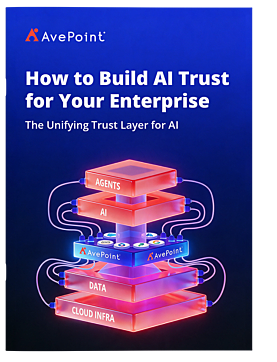
The Unifying Trust Layer for AI
Protect, secure, and govern your entire AI estate across data, infrastructure, and agents.
eBook
The Unifying Trust Layer for AI
"More than four in five organizations are confident they can prevent unauthorized AI data access. Yet 62% to 72% still experienced an AI-related incident in the past year."
What’s Inside
As AI adoption expands, organizations need current evidence that their AI environments operate within approved security, governance, resilience, and financial boundaries. Without connected visibility and accountability, a gap can emerge between what leaders believe about AI and what the organization can demonstrate.
Consider the scale of the challenge:
- 46.9% of employees already rely on AI agents daily or weekly.
- 21.1% of organizations cannot determine whether unsanctioned agents exist in their environment.
- 88.4% of organizations experienced an agent-related breach in the previous year.
- Nine in 10 organizations delayed generative and agentic AI deployments by an average of six months
Confidence is a starting point, but trust in AI requires evidence. Leaders face increasing pressure from boards, regulators, customers, and internal stakeholders to prove the AI environment operates within approved policies, controls, and business boundaries.
What You’ll Learn
This eBook explores how enterprise organizations can build a unified trust layer that provides visibility, accountability, resilience, and governance across their expanding AI estate.
- Define AI trust as an outcome. Connect policies, risk assessments, enforceable controls, and evidence to show whether AI operates as intended.
- Identify and close the AI trust gap. Compare what your organization believes about its AI environment with what its controls and records can demonstrate.
- Evaluate the six components of a modern AI trust layer. Strengthen governance across people, data, applications, AI models, agents, and infrastructure.
- Modernize data classification for AI. Move beyond static labels with continuous, lifecycle-aware classification that reflects how data is accessed and used.
- Improve AI agent accountability. Gain visibility into agent usage, permissions, ownership, activity, and cost to support informed governance decisions.
- Connect AI cost management to governance. Use financial accountability to expose unmanaged activity, control spend, and reinforce trust.
Turn AI Trust Into a Defensible Business Advantage
AI innovation moves faster when leaders can demonstrate that governance, security, resilience, and financial accountability work together. Build the evidence-based foundation your organization needs to scale AI with greater control, clarity, and confidence.
Get the AvePoint ebook to close the gap between confidence and provable AI trust.
Frequently Asked Questions
1. What is a unified trust layer for AI?
A unified trust layer for AI is an enterprise-wide foundation that connects governance, security, resilience, accountability, and cost visibility. It helps organizations produce current evidence that AI systems, models, agents, data, applications, and infrastructure operate within approved policies, controls, and business boundaries.
2. Why is AI trust important for enterprise AI adoption?
AI trust helps leaders move beyond confidence and demonstrate that AI is being used securely, responsibly, and within defined operational and financial boundaries. This evidence supports informed decisions, clearer accountability, stronger oversight, and more controlled AI adoption at scale.
3. How can organizations close the AI trust gap?
Organizations can close the AI trust gap by connecting policies and risk assessments with enforceable controls, continuous data classification, AI agent visibility, operational resilience, and financial accountability. Together, these capabilities make it easier to compare what the organization believes with what its controls and records can prove.