

AI agent security best practices include identity management, observability, guardrails, audit trails, and recoverability controls that reduce the risk of autonomous AI agents taking unreviewed, damaging actions. AvePoint's State of AI 2026 report found that 88.4% of organizations experienced at least one AI agent-related security breach in the past 12 months.
Key Takeaways
- AI agent breaches are now the norm, not the exception. AvePoint's State of AI 2026 report found that 88.4% of organizations experienced at least one AI agent-related security breach in the past 12 months.
- Data leakage and malicious manipulation are the top breach types. 50.1% of breached organizations experienced data leakage; 49.6% experienced manipulation of agents by malicious or untrusted inputs.
- Visibility into agents is collapsing as adoption accelerates. 21.1% of organizations don't know whether unsanctioned tools are being used to create AI agents at all.
- Agents are already doing real work. 46.9% of employees rely on AI agents weekly or daily, and agent-driven work processes are expected to double within 12 months.
- Internal readiness, not the technology, is the biggest barrier. Data quality, ROI clarity, and reporting and auditing top the list of rollout difficulties, ahead of data security exposure.
- Governance tools are becoming the top investment priority. 62.4% of organizations plan to increase investment in tools that monitor agent actions for policy alignment.
- A new category, agent management platforms (AMP), is forming to close this gap. Gartner projects AMP investment will exceed $15 billion by 2029, and that the average Fortune 500 company will manage more than 150,000 AI agents by 2028.
What Is AI Agent Security?
AI agent security is the set of controls, identity management, observability, guardrails, audit trails, and recoverability that govern what autonomous AI agents can access, what actions they can take, and how those actions are reviewed and corrected. It differs from generative AI security because agents act on their own instead of only responding to a prompt.
AvePoint's State of AI 2026 report surveyed 750 respondents with direct responsibility for information management, data security, or AI programs. Its agent-specific finding is stark: AI agents reason probabilistically and act autonomously within whatever permissions and data they are given, so when governance guardrails are incomplete or outdated, agents can bypass controls in ways that threaten data security, privacy, and compliance.
The practical shift for security teams is that the risk moves from flawed output to flawed action. A generative AI (GenAI) tool that produces a wrong answer creates a review task. An AI agent with standing permissions that acts on a wrong judgment can move a file, send a message, or update a record before anyone reviews it.
| GenAI Security | AI Agent Security |
| Controls what a model can access and produce | Controls what an agent can access, produce, and do |
| Risk: flawed or hallucinated output reviewed by a person | Risk: flawed autonomous action taken before a person reviews it |
| 89.5% of organizations had a related breach in the past 12 months | 88.4% of organizations had a related breach in the past 12 months |
| Top mitigation: employee training (66.9%) | Top mitigation: human-in-the-loop controls (most common of 95.5% who took action) |
| Governed primarily through usage policy | Governed through usage policy, identity, audit trail, and recoverability controls |
Why Do 88% of Organizations Get Breached by AI Agents?
About 88.4% of organizations experienced at least one security breach due to AI agents in the past 12 months, according to AvePoint's State of AI 2026 report. Data leakage was the most common breach type, affecting 50.1% of organizations, followed closely by manipulation of AI agents
Small readiness gaps scale into large risks at machine speed. Data with insufficient access controls or outdated permissions can be exploited by AI agents that operate faster than human oversight. Reasons why, the most widely cited concern about agents is incorrect judgments or inappropriate actions that damage data.
Among respondents who are extremely concerned, agents bypassing human-in-the-loop controls is the top issue. When an agent circumvents a safeguard meant to prevent harm, it combines incorrect judgment with autonomous execution instead of containing either one.
Traditional, human-centric risk controls do not translate cleanly to agent-driven workflows. Controls designed around a person pausing to make a decision struggle when an agent executes continuously, across systems, without a natural pause for review.
Why Is Agent Visibility Collapsing as Adoption Accelerates?
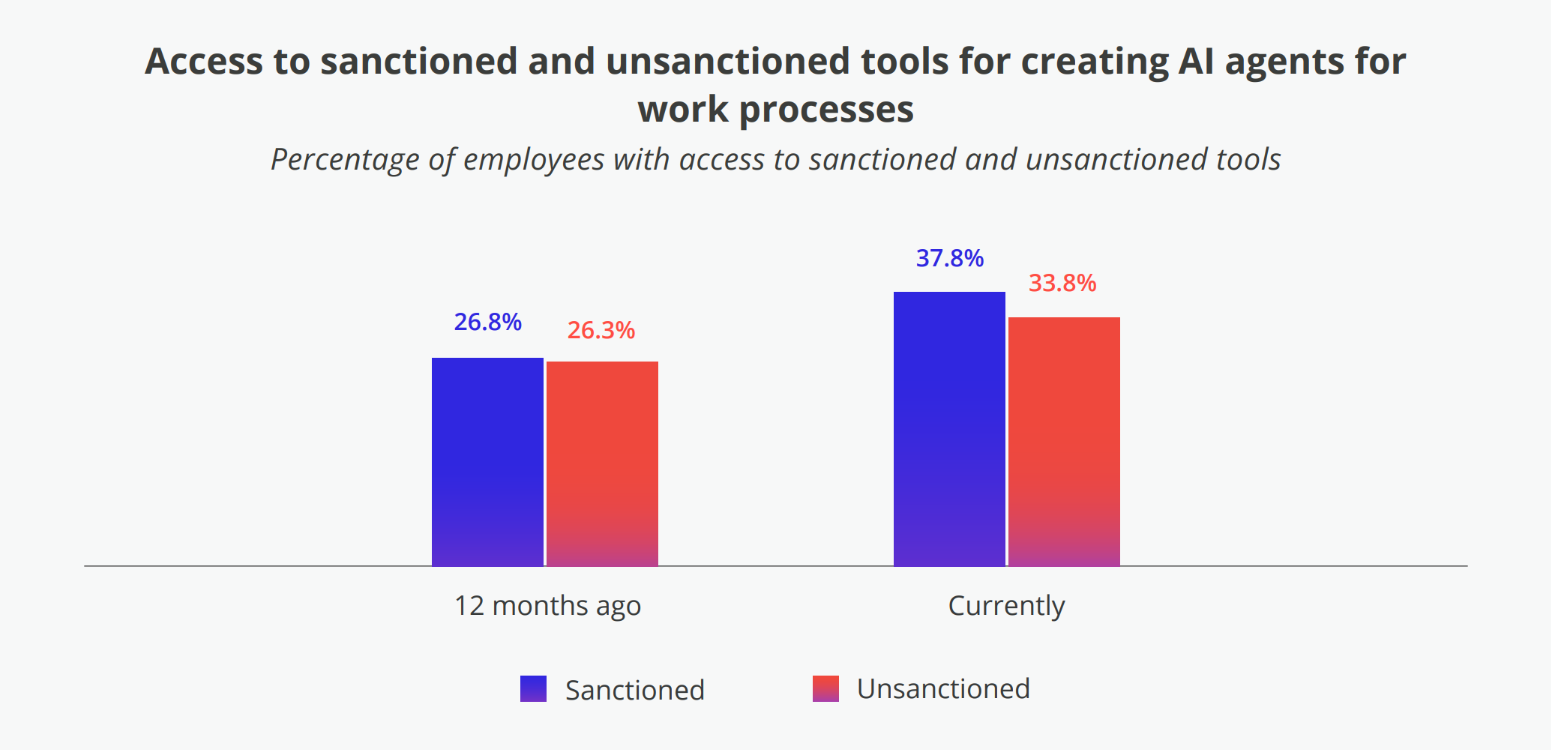
Agent visibility is falling behind because access to agent-creation tools is expanding faster than organizations can track it. Around one-third of employees currently have access to sanctioned or unsanctioned tools for creating AI agents. Access to sanctioned tools is expected to exceed half of employees within 12 months, while 21.1% of organizations do not know whether unsanctioned tools are being used to create agents at all.
That 21.1% figure is higher than the equivalent blind spot for GenAI (17.6%, itself nearly triple 2025's 6.3%), which tracks with what the report calls a structural pattern: Organizations are uncertain about which agents are running, how they were created, and whether unsanctioned or “shadow” agents are operating alongside approved systems. Uncertainty at this scale is not a minor gap: An agent nobody is tracking is a set of permissions nobody is reviewing.
What Are the 5 Essential AI Agent Security Practices?
The five essential AI agent security practices are identity management, observability, guardrails with human-in-the-loop review, audit trails, and recoverability. Together, they cover what an agent can access, what it is doing right now, what it is allowed to do without review, what it did, and how to undo it when something goes wrong.
- Identity management. Treat every AI agent like an employee from a guardrail perspective: Define up front what access it has, what authority it holds, and what data it can touch, rather than letting it inherit broad permissions by default.
- Observability. Maintain a live view of every agent running in the environment. This is the direct fix for the visibility gap described above, where up to one in five organizations cannot say whether unsanctioned agents exist at all.
- Guardrails and human-in-the-loop review. 95.5% of organizations have taken at least one action to address AI agent security concerns, and adding human-in-the-loop controls was the most common step, pulling back from full autonomy by adding verification before high-risk actions are executed.
- Audit trails. Keep an auditable record of every action an agent takes, not just its outputs, so security and compliance teams can reconstruct what happened after an incident instead of guessing.
- Recoverability. Build the ability to reverse or correct an unwanted agent action quickly. Recoverability is what turns a flawed autonomous action into a contained incident instead of a lasting one.
What Does the Agent Management Platform (AMP) Category Solve?
An Agent Management Platform (AMP) is a unified layer for visibility, lifecycle control, policy enforcement, and auditability across every AI agent in an environment, regardless of which platform built or deployed it. Gartner named the category because governing agents individually, tool by tool, does not scale once an organization has dozens or hundreds of agents in production.
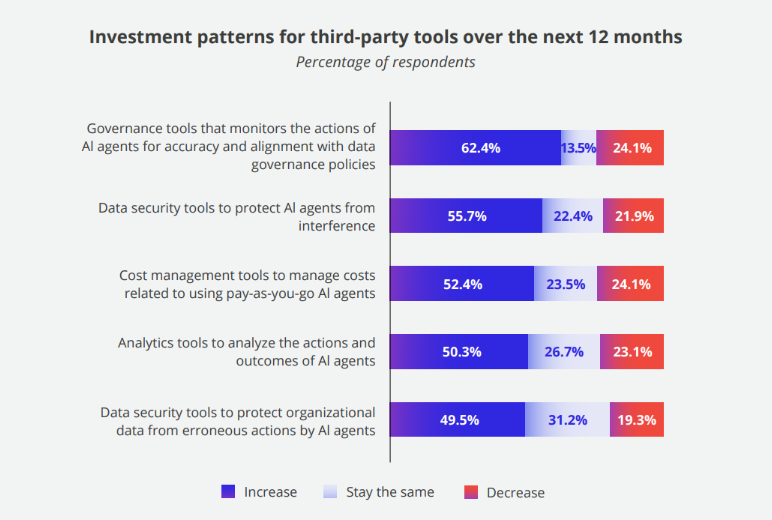
The scale problem is not theoretical. Gartner projects that enterprise investment in AMP technologies will exceed $15 billion by 2029, that the average Fortune 500 enterprise will manage more than 150,000 AI agents by 2028, and that by 2027, 75% of enterprises will consider agent monitoring methodologies among their most important AI management tools. AvePoint's State of AI 2026 report found that 62.4% of organizations plan to increase investment in tools that monitor AI agent actions for policy alignment over the next 12 months. This is the single highest-intent category among the governance investments the report tracked.
AvePoint AgentPulse is built to be a trusted agent management platform for exactly this problem. It gives security and IT teams a single inventory of every AI agent running across Microsoft 365 and Google Workspace, with risk flags, ownership assignment, and policy enforcement built in. Instead of governing agents one platform at a time, AgentPulse provides the unified visibility, lifecycle control, and audit trail an AMP is meant to deliver.
What Does AI Agent Security Look Like Across Microsoft 365, Google Workspace, and Salesforce?
AI agent security only works as an enterprise capability if it covers every platform where agents are being built, not just the first one an organization adopted. Agent-building tools now exist across Microsoft 365, Google Workspace, and Salesforce, and each platform produces agents with distinct identities, permissions, and potential impact.
A governance program that tracks agents built in Microsoft 365 but lacks visibility into those built in Google Workspace or Salesforce does not cover the full risk. It is covering only the platform that happened to be governed first. This is precisely the gap an Agent Management Platform is built to close: one inventory, one policy layer, and one audit trail across every cloud environment agents touch, rather than a separate, inconsistent process per platform.
How Is AI Agent ROI Different From Generative AI ROI?
AI agent ROI is measured by work displaced, accelerated, or augmented, not by how much an agent costs to run. AvePoint's State of AI 2026 report frames it directly: A $7 agent run that delivers $300 in process savings is a win for the business, even if it looks expensive on an IT invoice.
This is why AI FinOps is emerging as its own discipline. Unlike per-user software licensing, agentic AI generates variable spend, from large-language model (LLM) calls to reasoning traces to multiagent loops, that has to be attributed to outcomes to make sense of the cost. Reducing headcount ranks last among the reasons organizations give for using AI agents; increasing process efficiency, freeing employees for strategic work, and augmenting existing capabilities all rank higher. Security and governance readiness are part of that ROI equation too: an agent that causes a breach or has to be pulled back after an incident erases the savings it was deployed to capture.
What Should Organizations Do Before Deploying More AI Agents?
Organizations should inventory every agent already in production, fix the internal data readiness gaps that are the actual top barrier to agent rollouts, and put identity, observability, and audit controls in place before adding autonomy, not after. AvePoint's State of AI 2026 report found that internal readiness issues, not the technology itself, most commonly slow down agent deployments.
| Tier | Agent Governance Maturity | What It Looks Like |
| Tier 1: No inventory | Agents are deployed ad-hoc with no central record | Nobody can answer which agents exist, what they access, or who owns them |
| Tier 2: Partially managed | Sanctioned agent-creation tools are tracked | Shadow agents and cross-platform gaps still exist outside the sanctioned tool set |
| Tier 3: Unified (AMP) | One platform-agnostic layer for every agent | Visibility, lifecycle control, policy enforcement, and audit trails apply across Microsoft 365, Google Workspace, Salesforce, and every other environment agents touch |
- Inventory every agent in production today. You cannot govern what you have not counted, and roughly one in five organizations currently cannot answer this question.
- Fix data quality and reporting before scaling autonomy. These are the top-rated difficulties in rolling out AI agents, ahead of data security exposure itself.
- Fund governance tools ahead of new agent licenses. 62.4% of organizations are already redirecting investment toward tools that monitor agent actions for policy alignment.
- Add human-in-the-loop controls before removing them. It is the most common mitigation organizations have taken, and pulling back from full autonomy is a starting posture, not a failure.
- Build one governance layer across every cloud environment that agents touch. Microsoft 365, Google Workspace, and Salesforce each produce agents with their own identities and blast radius, and none of them should be the blind spot.
AgentPulse gives security and IT teams a single inventory of AI agents across Microsoft 365 and Google Workspace, with built-in risk flags, ownership assignment, and policy enforcement. This visibility helps teams secure agents that might otherwise remain undiscovered.
Frequently Asked Questions
What is AI agent observability?
AI agent observability is the ability to see which AI agents are running in an environment, how they were created, and what they are doing in real time. It is the prerequisite for agent governance, since 21.1% of organizations currently cannot answer whether unsanctioned agents exist at all.
What is a shadow AI agent?
A shadow AI agent is an agent created or deployed without formal IT or security approval, operating alongside sanctioned systems. Shadow agents increase exposure because they carry permissions and take actions with no clear accountability or oversight.
What is AI agent identity management?
AI agent identity management means treating every AI agent like an employee from a guardrail perspective: defining what access it has, what authority it holds, and what data it can touch, rather than allowing it to inherit broad default permissions.
What are the most common AI agent security breach types?
The most common AI agent security breach types are data leakage, affecting 50.1% of organizations that experienced a breach, and manipulation of agents through malicious or untrusted inputs, affecting 49.6%.
How many AI agents will enterprises manage by 2028?
Gartner projects that the average Fortune 500 enterprise will manage more than 150,000 AI agents by 2028, which is why centralized, platform-agnostic agent governance is becoming necessary rather than optional.
Related Questions

Jared Matfess is an AI Architect at AvePoint with over two decades of industry and consulting experience. A Microsoft MVP and a recently published author, he loves solving business problems with technology. He frequently speaks at industry events and conferences, inspiring teams to realize the full potential of their investment in Microsoft technologies.