

As digital transformation accelerates, organisations across industries are increasingly challenged to manage and migrate records securely, efficiently, and in compliance with evolving standards. The newly released Australian Standard AS 5393:2025: Records and information management – Migration of authoritative data, information and records between systems provides a comprehensive framework to ensure integrity, reliability, and usability throughout the process.
This blog explores the key elements of AS 5393:2025, its implications for organisations, and how AvePoint’s solutions can help organisations meet and exceed this Australian records migration standard.
What is AS 5393:2025?
AS 5393:2025 is a national standard developed by Standards Australia’s Committee IT-021, comprising of representatives from government archives agencies, universities, and industry bodies. It sets out requirements, specifications, and guidance for migrating records between systems in a way that preserves their authenticity, integrity, and accessibility.
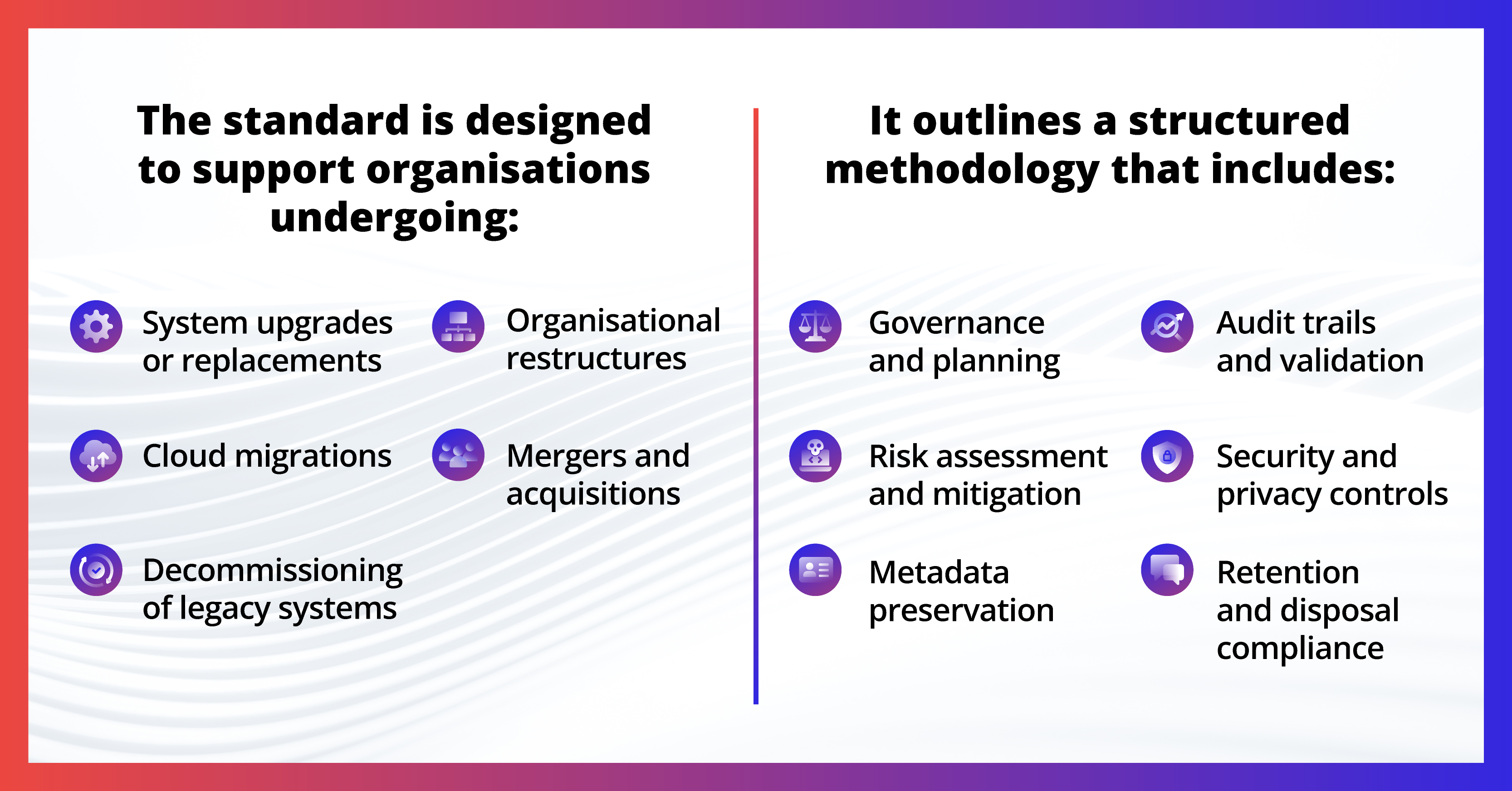
The standard also aligns with international best practices, referencing ISO standards such as AS/NZS ISO 30301 (records management systems) and AS ISO 16175.1 (functional requirements for managing digital records).
Why It Matters
Records migration is not simply a matter of transferring content from one platform to another; it’s a strategic process with significant compliance implications. In fact, according to Oracle, “83% of data migration projects either fail or exceed their budgets and timelines.” In addition to this, poorly executed migrations can result in a host of issues, including:
- Data loss or corruption.
- Non-compliance with legal and regulatory obligations.
- Inability to retrieve or verify records.
- Reputational damage.
- Increased operational risk.
AS 5393:2025 helps mitigate these risks by providing a blueprint for trustworthy, auditable, and compliant migrations. It emphasises the importance of maintaining provenance, ensuring that records remain reliable evidence of business activities.
How AvePoint MaaS Supports AS 5393:2025
AvePoint Migration-as-a-Service (MaaS) is a white glove service that provides a fixed price, fixed outcome, end-to-end migration for a vast array of sources and destinations — including Microsoft 365, SharePoint, Exchange, and other third-party platforms like Content Manager (TRIM), Documentum, RecFind, and Objective to name a few.
Here’s how it aligns with the standard:
- Metadata integrity and provenance. AS 5393:2025 compliance stresses the importance of preserving metadata and audit trails. AvePoint MaaS ensures that metadata such as creation dates, authorship, and classification is retained and mapped accurately during migration. This also supports achieving compliance with standards like AS ISO 23081 (metadata for records).
- Risk mitigation and validation. The standard outlines risks such as data loss, format incompatibility, and audit failure. AvePoint MaaS includes pre-migration assessments, migration pilots, and post-migration validation to ensure completeness and accuracy. It also supports rollback and contingency planning.
- Security and privacy. AvePoint MaaS enforces encryption, access controls, and compliance with privacy regulations. It supports secure migrations from on-premises to cloud environments, including hybrid scenarios.
- Governance and auditability. MaaS provides detailed logs and reporting, enabling organisations to demonstrate compliance with AS 5393:2025’s governance and audit requirements.
Together, these capabilities make AvePoint MaaS a reliable solution for organisations aiming to meet AS 5393:2025 migration requirements with confidence.
How AvePoint Opus Complements MaaS
AvePoint Opus is a SaaS-based information management solution that ensures migrated content is classified, retained, and disposed of in accordance with organisational policies and legal mandates.
- Lifecycle management. Opus supports the full lifecycle of records from ingestion to disposal, ensuring that migrated records remain compliant with retention and disposal authorities (RDAs), as required by AS 5393:2025.
- Intelligent classification. Using AI and machine learning, Opus can automatically classify records based on content and context, reducing manual effort and ensuring consistency.
- Transparency and accountability. Opus maintains audit trails, version control, and access logs, supporting the standard’s emphasis on traceability and accountability.
By extending governance beyond migration, AvePoint Opus ensures records remain compliant and well-managed throughout their lifecycle.
Real-World Case Studies
AvePoint MaaS has been successfully deployed across diverse sectors. The following use cases highlight how organisations have leveraged the service to meet regulatory requirements, preserve metadata integrity, and improve operational outcomes.
Bendigo Kangan Institute
Bendigo Kangan Institute, a major Victorian education provider, partnered with AvePoint to migrate over 10 TB of data to Microsoft 365 and build a compliant records management strategy from scratch. Their previous approach was inconsistent and lacked audit trails, making it difficult to locate records or meet Public Records Office of Victoria (PROV) standards.
With AvePoint’s help, they implemented automated classification, retention policies, and legal destruction protocols. The result was a centralised, compliant, and auditable records management system that aligned with AS 5393:2025 principles — particularly around metadata preservation, auditability, and lifecycle governance.
Cardinia Shire Council
Cardinia Shire Council, located in Melbourne’s southeast, undertook a strategic migration of 4.5 TB of data from HP TRIM and network drives to Microsoft 365. Their goal was to move from 50% to 100% record retention and achieve full compliance with the Office of the Victorian Information Commissioner and PROV standards.
In alignment with AS 5393:2025, Cardinia conducted a comprehensive analysis of all systems generating records, identifying gaps in coverage and risks associated with fragmented storage. Their approach reflected the standard’s emphasis on:
- Governance and planning. Cardinia’s leadership prioritised records compliance as a public duty, embedding it into their organisational culture.
- Risk management. They addressed risks of non-compliance and data loss by consolidating records into a single, auditable platform.
- Metadata and audit trail integrity. With AvePoint Opus, they ensured records were captured with full metadata and auditability, supporting long-term accessibility and trustworthiness.
- User-centric design. Cardinia recognised that compliance should be seamless for users. Their solution made it easier to do the right thing than the wrong thing — an ethos echoed in AS 5393:2025’s guidance on usability and system design.
Their efforts earned them the PROV Sir Rupert Hamer Excellence in Records Management award and positioned them as a leader in public sector information governance.
Why AvePoint?
AvePoint is a trusted Microsoft partner with over two decades of experience in data governance, compliance, and migration. Its solutions are used by over 17,000 organisations worldwide, including government agencies, financial institutions, healthcare providers, and Fortune 500 companies.
By combining AvePoint MaaS and Opus, organisations gain a comprehensive, standards-aligned solution for records migration and management — one that supports not just technical execution but also strategic governance and compliance.
AvePoint’s tools are designed to be scalable, secure, and adaptable to complex enterprise environments. Whether migrating from legacy systems, consolidating platforms, or embracing the cloud, AvePoint ensures your records remain authentic, accessible, and compliant — today and into the future.
Final Thoughts: Transforming Migration
AS 5393:2025 sets a new benchmark for records migration in Australia. It recognises that migration is not just a technical task but a governance-driven, risk-sensitive process that requires careful planning, execution, and validation.
AvePoint MaaS and Opus provide the tools and intelligence needed to meet these challenges head-on. By aligning with the principles of AS 5393:2025 records migration, AvePoint empowers organisations to transform migration from a risky necessity into a strategic advantage.


With over 20 years of experience across technical consulting and management, Bruce Berends has worked with an array of different businesses, organizations, and a range of technologies. He has a passion for product strategy and management, as well as compliance and global regulations. He currently works on AvePoint’s Resilience Suite (Information Management & Data Protection), which forms part of the AvePoint Confidence Platform.