

Growth should expand opportunity — not strain the operating model of a managed service provider (MSP). Yet for many MSPs, growth brings rising complexity that outpaces their ability to scale.
As customer numbers increase, so does operational complexity. More tenants mean more tools, more manual administration, and more opportunities for inconsistency. The outcome is predictable: higher efforts, tighter margins, and limited scalability, even in growing businesses.
Industry research from Omdia highlights the gap: while 94% of MSPs are committed to automation, fewer than half have reached delivery maturity. The challenge is not ambition; it is the operating model.
Leading MSPs are addressing this by redesigning how services are delivered. Instead of automating only existing processes, modern MSPs are standardizing, centralizing, and automating operations through multitenant management.
The Challenge: Why MSP Growth Stops Scaling
As customer environments multiply, operational friction accumulates across three core areas:
- Tool sprawl across monitoring, security, backup, identity, and reporting
- Tenant‑by‑tenant administration, requiring repeated effort for the same tasks
- Inconsistent processes, where service delivery varies by customer or engineer
Over time, this friction quickly turns into operational fatigue. Engineers move between portals, re‑enter similar configurations, and repeatedly solve the same problems across tenants. Onboarding slows, burnout increases, and service consistency declines.
Each new customer adds overhead. Each exception increases complexity. Every manual process consumes engineering time that cannot be reused. With labor accounting for around 40% of MSP operating costs, people‑dependent delivery models quickly become unsustainable at scale.
The Solution: Multitenant Management for Unified Operations
The foundation of scalable MSP operations is moving away from tenant‑by‑tenant administration and toward multitenant management.
Multitenant management is not just about visibility. It is about centralizing operational control, enabling MSPs to deliver services consistently across all customer environments.
In a mature multitenant model, MSPs gain:
- Centralized visibility across all tenants
- Unified control of users, devices, and configurations
- Consistent operational workflows
- Standardized reporting and compliance outputs
- Reduced reliance on manual, repetitive administration
This level of consistency is becoming a competitive differentiator. MSPs that can enforce standardized controls across tenants are better positioned to manage risk, monetize governance services, and support AI‑driven initiatives at scale.
Consistency enables optimization. Optimization enables scale.
Standardization: Define Once, Apply Everywhere
With multitenant management in place, MSPs can standardize service delivery. Standardization replaces variation with repeatability.
Rather than building bespoke environments for every customer, MSPs define service baselines and apply them consistently across all tenants. Common examples include:
- Security and compliance configurations
- Microsoft 365 policies and governance frameworks
- User provisioning and lifecycle processes
- Backup and retention policies
- Monitoring thresholds and alerting rules
- Patch and maintenance schedules
- Standardized reporting templates
Omdia’s survey of 333 global MSPs shows that standardizing governance and operational controls is essential to overcoming scale constraints, particularly as services expand into AI readiness and continuous compliance.
The benefits of standardization include:
- Faster onboarding. New customers are deployed using proven templates instead of manual builds.
- Improved margins. Engineers spend less time on repetitive work and more time on high‑value services.
- Reduced operational risk. Standard configurations minimize misalignment, configuration drift, and security gaps.
- Simpler team scaling. New engineers become productive faster within structured processes.
- Predictable service delivery. Customers receive consistent outcomes regardless of who supports them.
Standardization doesn’t remove flexibility. It creates a controlled foundation that enables scale.
Centralization: One Platform to Manage Thousands of Customers
Standardization alone is not enough if operations remain fragmented.
Without centralization, MSPs still log into multiple systems per customer, repeat the same administrative tasks, switch constantly between tools, and manually reconcile data across environments.
As governance and compliance expectations move from one-off projects to continuous oversight, fragmented operations quickly become a ceiling on growth.
Centralized multitenant operations provide the visibility and control needed to scale customers without scaling complexity at the same rate.
Automation: The Efficiency Multiplier
Automation becomes effective only after standardization and centralization are in place. Without standards, automation accelerates inconsistency. With structured processes, it becomes an efficiency multiplier.
High‑value automation opportunities include:
- Customer onboarding and provisioning
- User lifecycle management
- Security and compliance remediation
- Patch management and maintenance
- Scheduled reporting and service reviews
When these workflows are automated, MSPs shift effort away from routine administration and toward higher‑value work such as advisory services, security design, and governance strategy.
Scale: Growth without Adding Headcount
When multitenant management, standardization, and automation work together, MSPs unlock a different growth model — one that scales operational capability rather than headcount.
This enables MSPs to:
- Support more customers per engineer
- Reduce onboarding time
- Maintain consistent service quality at scale
- Improve margins through efficiency
- Reduce dependence on individual “hero” engineers
This shift is critical as compliance and governance services are forecast to grow by more than 20% year‑on‑year, increasing demand without reducing complexity.
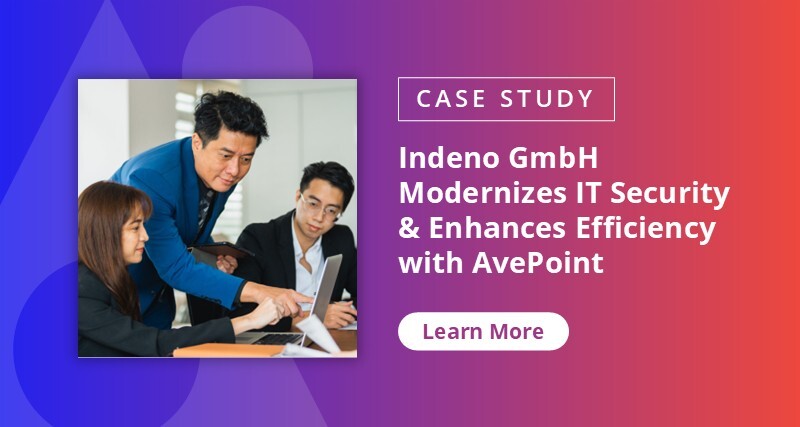
Proof in Practice: Indeno’s Operational Transformation
This approach is already delivering measurable results.
By standardizing Microsoft 365 delivery with AvePoint Elements, Indeno GmbH moved from manual, tenant‑by‑tenant provisioning to a scalable, platform‑driven operating model.
Results included:
- Tenant provisioning reduced from approximately 30 hours to under one hour
- Engineering effort reduced to approximately 30 minutes per tenant
- New environments delivered with 85%+ Microsoft Secure Scores
- Faster onboarding and time to value
- Consistent security posture across deployments
This demonstrates the shift from bespoke service delivery to repeatable, scalable operations.
How AvePoint Helps MSPs Scale
To operate efficiently at scale, MSPs need more than disconnected tools. They need a unified operational platform designed for multitenant environments.
AvePoint supports MSPs through:
- Centralized multitenant visibility
- Baseline enforcement and standardization
- User and device lifecycle management
- Policy control with operational consistency
- Automation across Microsoft cloud environments
This directly addresses the intent–execution gap identified by Omdia — bridging automation ambition with scalable delivery.
Ready to Scale without Adding Complexity?
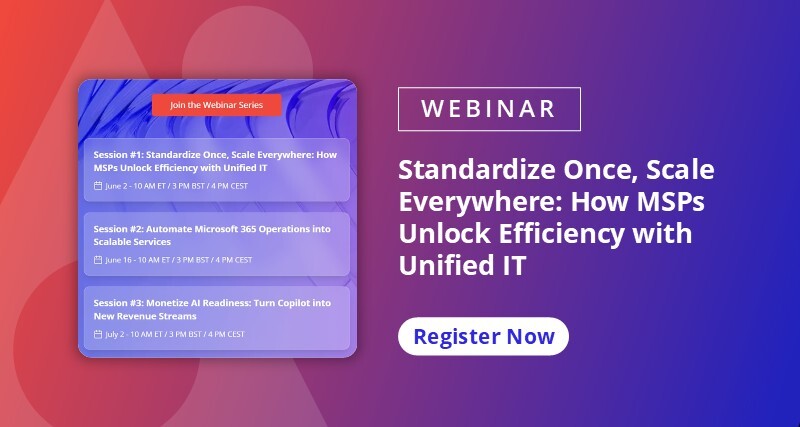
Join our three-part webinar series (30 minutes per session) designed for MSPs who want to remove operational complexity, protect margins, and build new recurring revenue streams.
Discover how standardized, multitenant operations help modern MSPs grow profitably.

Tawanda Matongo is a Product Marketing Manager at AvePoint, driving GTM strategy for AvePoint Elements and channel-focused solutions. With expertise in B2B SaaS, channel marketing, and partner enablement, he helps MSPs scale secure, multi-cloud services. Tawanda draws on experience from Ingram Micro, Microsoft, and VMware, and is passionate about transforming market insights into high-impact campaigns that drive measurable growth.