

Scaling Microsoft 365 services should drive revenue growth, not increase operational overhead. Managing a single customer is straightforward. But for managed service providers (MSPs) handling 50 to 100 clients, each configuration, security requirement, and user lifecycle introduces complexity that most MSPs hit a wall with.
According to IDC, 47% of organizations indicated that the number of tools they use has increased year over year. This tool sprawl highlights the need for end-to-end visibility and tool consolidation to manage costs and improve efficiency. As MSPs expand their customer base, operational weight grows alongside it.
Configuration drift, manual onboarding, and inefficient processes contribute to engineering hours wasted on tasks that should have been automated. What should be a growth story becomes a margin problem. The root cause is almost always the same: fragmented tooling and tenant-by-tenant management that are difficult to scale.
Why Native Microsoft 365 Tools Fall Short for MSPs
Microsoft 365 was built for single-tenant administration. For an MSP managing multiple clients, this means engineers logging into separate environments, repeating administrative tasks for every client, and manually assembling reports before each business review.
The predictable result is portal fatigue, slower onboarding, inconsistent delivery, and a hard ceiling on customer capacity each engineer can support. While Microsoft 365 Lighthouse helps at the margins, its licensing restrictions and limited automation mean many MSPs still need a purpose-built third-party multitenant management solution to operate sustainably.
What Is Microsoft 365 Multitenant Management?
Microsoft 365 multitenant management enables MSPs to administer all customer environments from a single centralized platform. This includes enforcing consistent policies, automating user lifecycle workflows, monitoring security across tenants, and generating compliance reports without logging in to each environment individually.
For MSPs, this centralized approach is foundational to scaling service delivery without increasing headcount. By adopting a purpose-built multitenant platform that automates repetitive tasks – onboarding, offboarding, policy enforcement, and reporting – MSPs manage significantly more clients per engineer and convert operational work into packaged, billable services.
The Shift: From Reactive Tasks to Packaged, Billable Services
Leading MSPs are moving beyond reactive, ticket-based work toward structured, packaged delivery models. Work that once lived in spreadsheets and service queues becomes standardized, repeatable, and billable.
- Onboarding becomes a defined service offering.
- Security baseline deployment becomes a recurring line item.
- Governance and compliance reporting become a value you charge for — not a cost to absorb.
Automation protects MSP margins by eliminating the manual tasks that drive up operational costs – user provisioning, offboarding, compliance reporting, and alert triage – and converts them into packaged, billable services with predictable delivery and stronger margins.
The following are three pillars that make scalable Microsoft 365 operations possible:
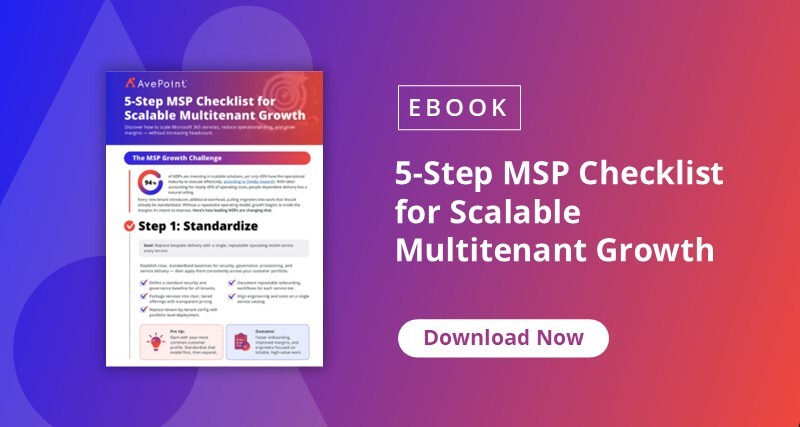
1. Standardize: Build Once, Deploy Everywhere
Define configurations, policies, and governance settings once — then deploy them consistently across every client. MSPs are no longer selling time; they are selling a service.
- Apply consistent Microsoft 365 configurations across all tenants from a single console.
- Deploy security baselines aligned to CIS Benchmarks, NIST, and Microsoft Secure Score.
- Onboard new clients to your standard immediately, not over weeks of manual work.
- Package standards into tiered service offerings that clients can buy and upgrade.
Outcome: Faster onboarding, fewer errors, and a delivery model that holds quality at any scale, without repeating the same work for every new client.
2. Automate: Recover Hours, Protect Margins
Onboarding, offboarding, multifactor authentication (MFA) resets, license management, compliance reporting — these are the Microsoft 365 tasks consuming the most MSP engineering time, and the ones most suited to automation.
- Clone template users to onboard employees quickly and consistently.
- Schedule offboarding so license reclamation and access removal run automatically.
- Generate white-labelled client reports on a schedule, without manual effort.
- Integrate with professional services automation (PSA) and remote monitoring and management (RMM) platforms to streamline ticket creation and response.
Outcome: Every hour recovered is time available for higher-value work — or for supporting more customers without growing the team. That’s how MSPs increase revenue per engineer while keeping costs flat.
3. Secure: Turn Security Into a Scalable Service
Without central visibility across tenants, risk accumulates quietly. Settings drift, changes go untracked, and threats surface in environments that haven’t been reviewed recently.
- Monitor surface risks for every client from a single dashboard.
- Detect and remediate baseline deviations without manual intervention.
- Respond quickly to risky behaviors, including impossible travel and suspicious sign-ins.
- Generate audit-ready compliance reports to reduce pre-review workload.
Outcome: Security stops being an overhead for the MSP. When delivered transparently, it becomes a trusted service clients recognize, value, and pay for.
Essential Security Capabilities for Microsoft 365 Multitenant Automation
Not all multitenant Microsoft 365 management platforms offer the same level of capability. MSPs should evaluate solutions based on the following:
- Centralized policy templates. Configure security and compliance policies once and deploy across all tenants — eliminating per-client manual effort and configuration drift.
- Automated drift detection and remediation. Continuous baseline monitoring with automatic correction ensures tenants stay compliant without ongoing technician involvement.
- Role-based access control (RBAC). Enable L1 and L2 technicians to handle routine tasks safely, freeing senior engineers for complex issues.
- Automated branded reporting. Schedule white-labelled reports delivered to clients without technician involvement, demonstrating service value at every touchpoint.
- User lifecycle automation. Standardize user cloning, scheduled offboarding, and automatic license reclamation to eliminate manual checklists and reduce errors.
- PSA and RMM integration. Connect Microsoft 365 alerts to generate PSA tickets automatically. Billing data flows without manual entry. Engineers work from the tools they already use.
A case study: Indeno GmbH cut Microsoft 365 tenant provisioning from 30 hours to under one hour, with as little as 30 minutes of active effort. Every new tenant is now provisioned with a Secure Score of over 85%, consistently from day one.
"AvePoint Elements has significantly simplified and automated our internal processes in security baseline management — the increase in efficiency and quality is substantial." – Indeno GmbH.
The AI Opportunity: Why the Foundation Matters Now
AI is the next major growth lever for MSPs and their clients, but most deployments stall because of what’s underneath them. Poor data quality, ungoverned Microsoft 365 environments, and oversharing risks make AI outputs unreliable and make it nearly impossible to demonstrate ROI.
If you are ready to scale your Microsoft 365 practice, see how AvePoint helps MSPs automate and scale multitenant management.

Tawanda Matongo is a Product Marketing Manager at AvePoint, driving GTM strategy for AvePoint Elements and channel-focused solutions. With expertise in B2B SaaS, channel marketing, and partner enablement, he helps MSPs scale secure, multi-cloud services. Tawanda draws on experience from Ingram Micro, Microsoft, and VMware, and is passionate about transforming market insights into high-impact campaigns that drive measurable growth.