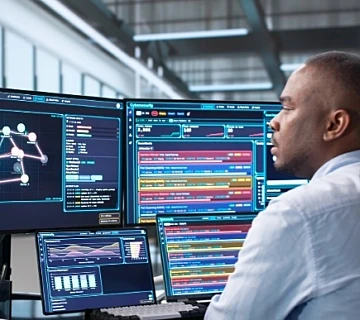

The fastest way to make an AI initiative look impressive is to keep it away from reality.
Start with a clean dataset, keep the workflow simple, avoid difficult integrations, prepare the prompt carefully, and run the demo in an environment where access rights, latency, monitoring, cost, rollback, and ownership do not yet need to be considered.
Under those conditions, almost every AI system looks more capable than it really is.
That does not make the demo dishonest, but it surely makes it incomplete.
The real test begins when the system leaves the controlled environment and operates under normal business conditions. Real data is messy, users do unexpected things, and systems carry years of decisions no one fully remembers. Permissions, audit trails, cost, and failure behavior all start to matter. And the solution has to keep working after the person who built the prototype has moved on to the next project.
This is where many AI initiatives tend to break. Not because the model is weak, but because the foundation underneath it was never designed for production.
Production Readiness Is Not the Final Step
Many organizations treat production readiness as something that happens late in the process. First, the team proves the idea. Then someone thinks about deployment. Security gets involved later. Operations asks how the system will be supported while finance asks what it will cost at scale. At that point, the project often looks far less ready than it did in the demo.
That sequence is backward.
Production readiness is not a layer added after the clever part is complete. It is the condition that determines whether the clever part can create value at all.
According to AvePoint's State of AI report, 86.9% of organizations delayed generative AI deployments by an average of nearly six months due to data security and data management concerns, with AI agent deployments delayed at nearly the same rate. McKinsey research found that only 1% of C-suite leaders describe their generative AI rollouts as mature. The data suggests the challenge is no longer proving AI can work, but proving it can operate reliably in production.
A model that only works with manually prepared data is not production-ready. A workflow that depends on someone copying results between systems is not production-ready. A solution that cannot be monitored, rolled back, or operated by anyone other than its original builder is not production-ready.
The uncomfortable truth is that many AI prototypes are not early versions of production systems. They are separate artifacts built under different rules. They may demonstrate what is possible, but they do not prove that the organization can run it.
Real Data Changes Everything
Synthetic data and carefully curated samples are useful during exploration. They help teams test an idea quickly without waiting for full system access or approvals. But they also hide the hardest part of enterprise AI: the gap between how a process is documented and how it actually works.
Real data contains missing fields, inconsistent categories, duplicate records, and old naming conventions. It often includes manual corrections, exceptions, and business meaning that exists only in people’s heads. A field called “customer” may mean different things in sales, finance, and support. A status value may have evolved over time. A spreadsheet maintained by one team may contain corrections that never made it back into the official system.
Humans learn to navigate these inconsistencies. AI systems do not — they process what they receive.
This is why connecting a prototype to real data can feel like the moment the magic disappears. The model has not become worse. It finally encountered the organization as it is.
A production-ready AI system must therefore be tested against real operational data early. Not after the demo or once leadership has already approved the rollout. Early testing helps teams determine whether the data is usable, whether the definitions are stable, and whether the system can handle real conditions without constant intervention.
Repeatable Beats Impressive
The next production-readiness test is repeatability.
Can the system be deployed again by someone else, in another environment, without reconstructing the process from memory? Can the data pipeline run automatically? Are prompts, configurations, infrastructure settings, and deployment scripts versioned? Is there a clear path from development to test to production? Can the team explain which version is running and why?
If the answer to these questions is unclear, the system is likely still a prototype, no matter how impressive the output looks.
This becomes even more important with AI agents and multi-step workflows. Agents are often presented as the next leap in enterprise automation because they can call tools, retrieve information, make decisions, and execute tasks across systems. But the more steps a system performs, the more important production foundations become.
88.4% of organizations experienced at least one AI agent-related security breach in the past 12 months, with sensitive or confidential data exposure emerging as the most common incident. An agent without reliable identity handling, versioned deployment, observability, and rollback is not autonomous. It is unpredictable automation with a fancy interface.
Agents do not remove the need for engineering discipline. They increase it. Every tool call requires appropriate permissions. Every action needs traceability. Every decision path needs to be observable. Every failure needs a safe fallback. Otherwise, the organization has not built an agentic system. It has built a black box that can move faster than the governance around it.
Monitoring Is Not Optional
A demo only needs to work once. A production system has to keep working.
Organizations need visibility into what the system is doing after go-live. It should address the following questions:
- How many requests does it process?
- How often does it fail and how long does it take to respond?
- How much does each run cost?
- How often do users override the output?
- Which inputs cause problems?
- When does the system abstain?
- When does it produce something that looks valid but is not useful?
Without this visibility, the system is not being operated. It is being assumed to work. Monitoring is often treated as a technical concern, but it is also a trust concern. Users trust systems that behave predictably and visibly. Operations teams trust systems they can diagnose. Compliance teams trust systems that leave evidence. Finance teams trust systems whose cost can be understood before the invoice arrives. If nobody can see what the system is doing, nobody can responsibly own it.
Rollback belongs in the same conversation. Production-ready systems need a reliable way back. If a new model version underperforms, if a prompt change behaves unexpectedly, or if an integration fails, the organization must be able to disable, revert, or route around the AI path quickly. “We will fix it manually” is not a rollback strategy. It is a big warning sign.
Integration Is Where Value Appears
AI does not create value because it generates an answer. It creates value when that answer changes how work happens. That shift depends on integration.
A classification model that writes its result into a separate dashboard may be useful. A classification model that routes the case inside the existing service system is operational. A summarization tool that produces text in a side window may save a few minutes. A summarization capability embedded into the actual review workflow can change how that workflow runs.
The difference is not the model, but integration. Boston Consulting Group's research quantified this gap: only 5% of companies are achieving AI value at scale, while 60% report no material value despite substantial investment. The organizations generating the most value are not those running the most experiments — they are the ones integrating AI into core business functions.
Many AI initiatives delay integration because it exposes enterprise complexity. Identity systems, access controls, APIs, legacy platforms, data ownership, and exception handling all come into play. But avoiding that complexity also avoids the value. A system that sits beside the workflow will always remain easier to ignore than a system that improves the workflow itself.
Cost Is Part of Architecture
AI prototypes often appear inexpensive because they run at prototype volume — a handful of users, a limited dataset, minimal model calls, and a short test window.
Production shifts the economics. Usage grows, more systems connect, more employees depend on the output, and the volume of model calls increases. Logging, storage, monitoring, security, and support all layer on cost. Suddenly, the system that looked inexpensive during the proof of concept requires an operational budget. This should not be a surprise, but often it is.
Cost controls need to be designed into the system from the start. That includes spend alerts, usage dashboards, model selection rules, caching strategies, rate limits, and clear visibility into cost per transaction or cost per workflow. Otherwise, teams only discover the real economics after the system has already become useful enough that shutting it down is politically difficult.
A production-ready AI system is not only technically stable. It is also economically understandable.
What “Production-Ready” Should Mean
A practical definition of production-ready AI should be concrete enough that teams can use it as a decision filter.
A system is production-ready when:
- It uses real data through repeatable pipelines — not manually prepared samples.
- It moves through versioned deployments — not one-off changes.
- It has monitoring, logging, cost visibility, and rollback.
- It integrates with the systems where work actually happens.
- It has clear ownership for operation, support, and improvement.
- It can fail safely without disrupting the business.
This definition is not glamorous. That is the point. Many AI initiatives do not fail because they lack cleverness. They struggle because cleverness outpaces the foundation required to support it. The model works, but the data pipeline was fragile. The demo is compelling, but there is no deployment path. The agent completes a task, but nobody can explain what it did when something went wrong. The output looks useful, but it never enters the real workflow.
Production readiness is the discipline that prevents those gaps from becoming permanent.
The next generation of enterprise AI will not be won by the organizations with the longest list of experiments or the most exciting agent demos. It will be shaped by the organizations that can run AI under normal business conditions, with real data, real users, real governance, and real accountability. That is less flashy than another prototype, but it is also where the value finally starts.
If this feels familiar, the next step is to stop asking whether a use case is clever enough and start asking whether it is ready to operate in production. The Escape PoC Prison Starter Kit helps organizations make that assessment practical and define what needs to change before promising AI ideas can become systems that truly work in practice. Use code SHIFTHAPPENS10 for a discount on the Enterprise Self-Run Toolkit.