

As the annual gathering for higher education technology leaders, EDUCAUSE has always been a bellwether for what’s next in campus innovation. This year’s conference, held October 27 – 30, 2025, felt like a turning point. The conversations weren’t about whether transformation is coming — they were about how to do it right, and what’s at stake if you don’t.
What stood out most on the exhibition floor and in sessions was a shared sense of urgency. Higher education is ready to move past theoretical debates and embrace strategic investments in two non-negotiable areas: building AI trust and achieving data unification. These themes came up again and again, and the stories I heard offer a clear path forward for institutional resilience and growth.
The Strategic Investment in AI Trust
There’s no question that higher education is moving toward AI adoption. The goal is clear: enhance teaching and operational efficiency, but not at the expense of the student experience. The real challenge is making sure AI augments learning, rather than diminishing its quality.
Building Trust is the Foundation of Data Quality
Gartner’s principle is simple but powerful: AI trust is rooted in data quality and accessibility. For higher education leaders, this means adopting a formal management system that goes beyond compliance checklists. The AI trust, risk, and security management (TRiSM) framework is gaining traction as a way to ensure AI models are responsible, fair, and secure. It’s about turning data governance into the ultimate AI enabler, not just a box to tick.
But frameworks alone aren’t enough. The culture of enablement is what sets successful institutions apart. The ones making real progress aren’t just deploying AI; they’re investing heavily in change management to bring faculty and staff along for the journey. The goal is to position AI as a trusted, collaborative tool, not a shortcut or a threat.
Gaining Visibility and Control
Visibility is the next frontier. Leaders need tools that show how AI is actually being used on campus. Tools that provide visibility, such as prompt analysis, let leaders and institutions understand usage patterns for tools like Copilot — ensuring responsible and compliant adoption.
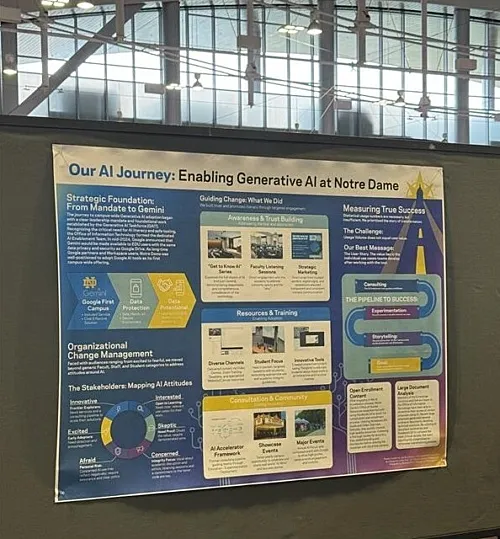
Notre Dame’s story on the exhibition floor is a standout example. They didn’t just roll out AI and hope for the best. Instead, they started with a clear framework for trust. Faculty were involved from the beginning, so AI was seen as a partner in teaching rather than a threat to academic integrity.
Transparency was key: The University of Notre Dame openly communicated how AI would be used, what data it would access, and how it would support – not replace – human judgment. Training sessions and feedback loops helped faculty feel confident that AI would enhance learning outcomes. This collaborative approach positioned AI as a tool for improving operations and the student experience, rather than as a shortcut for students to cheat.
Unification as the Catalyst for Growth
AI transformation cannot happen without unifying data first. The conversations at EDUCAUSE highlighted a major opportunity: overcoming the hurdle of fragmented data and workflows to accelerate digital transformation. By tackling fragmentation, IT teams gain a clear handle on their systems and data, significantly reducing integrity risks and unlocking the insights needed for transformation. With consolidation sweeping higher education, data unification is a strategic imperative for institutions pushing for digital transformation.
Unifying Data for Institutional Strength
As colleges and universities navigate growing challenges – like enrollment declines of 8% – 10% since 2010 and increasing financial pressures – the need to bring data together across departments has never been more critical. This isn’t just about technology; it’s about building a foundation for smarter decisions and stronger outcomes.
The urgency is clear: Higher education mergers and acquisitions have tripled in recent years, and the education sector is maintaining strong momentum. In fact, as of early 2025, most activity is concentrated in three areas:
- Professional training (20%), driven by reskilling and bigger learning and development (L&D) budgets
- Edtech (18%), fueled by digital transformation and AI-powered learning
- Early careers (18%), supported by demand for talent pipelines and apprenticeships
Institutions that embrace integrated data systems can unlock insights to improve student success, streamline operations, and position themselves for resilience and growth.
One State University leader I spoke to put it plainly: Unifying fragmented data is the key to moving forward. When data is scattered across departments and systems, it’s nearly impossible to extract meaningful insights about students and faculty. Unification unlocks the ability to use data to drive decisions and improve outcomes – but without it, systems are like an echo chamber of reactionary decision-making.
Maximizing the ROI of the Unified Cloud Data Estate
Of course, moving to a unified cloud data estate is an investment. But institutions have to weigh this investment decision against the hidden costs they’re absorbing every day: slower, fragmented operations; inability to make data-driven strategic decisions; high IT support overhead; and missed opportunities at a time when enrollment is under pressure.
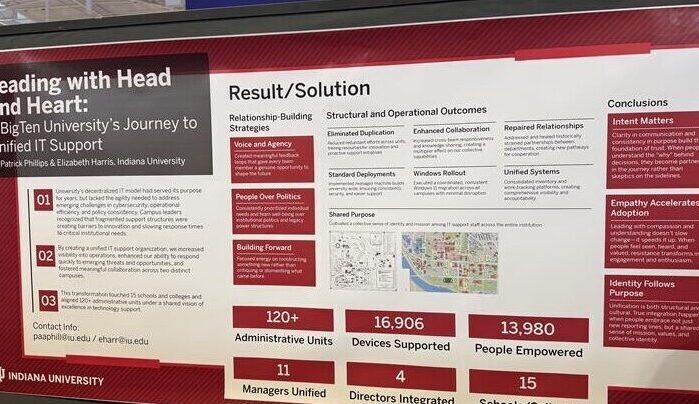
Indiana University’s experience is a great example of what’s possible. They recognized that fragmented data was slowing down transformation and creating inefficiencies across departments. Their strategy focused on building a centralized cloud-based data estate, making all student and faculty information accessible and consistent. They paired this with integrated support systems, which reduced IT ticket volume and improved response times.
By consolidating workflows and standardizing processes, Indiana unlocked the ability to extract meaningful insights from their data — something that was previously impossible due to mismatched systems.
The Path to Future-Ready Higher Education
Cloud migration is a means to an end, but the non-negotiable first step is data classification. Leaders left EDUCAUSE 2025 empowered with a clear vision: by prioritizing data integrity for AI trust and unification for operational growth, higher education can successfully navigate data challenges and secure a more resilient, innovative future. And a platform that unifies data, workflows, and AI governance provides the cornerstone institutions need for simplifying complexity, maintaining integrity, and moving forward with confidence.

Ava Ragonese is a Product Marketing Manager at AvePoint, leading the GTM of data security solutions for Google Workspace and Cloud. She helps organizations focus on quality data and insights to drive innovation and how multi-cloud collaboration can impact businesses. Ava has a M.Eng. in Systems Analytics from Stevens Institute of Technology and enjoys bringing her technical acumen to complex business decisions such as AI adoption.